Branded Search AI Overview: What Google Says About Your Name
Key takeaways
- When someone types your practice's name into Google, a branded search AI overview often answers before your own website appears, and much of what it says can come from platforms you barely control.
- The fix is not a trick: search your own name, write down which sources the summary cites, and then publish steady, first-hand posts on your own site so the summary has accurate facts from you to draw on.
When someone types your practice's name into Google, a branded search AI overview often answers before your own website appears, and much of what it says can come from platforms you barely control. The fix is not a trick: search your own name, write down which sources the summary cites, and then publish steady, first-hand posts on your own site so the summary has accurate facts from you to draw on.
What does a branded search AI overview show for a practice name?
A branded search AI overview is the summary Google writes at the top of the results when someone types your practice’s own name. It usually appears before your site, so a patient may read Google’s account of you first.
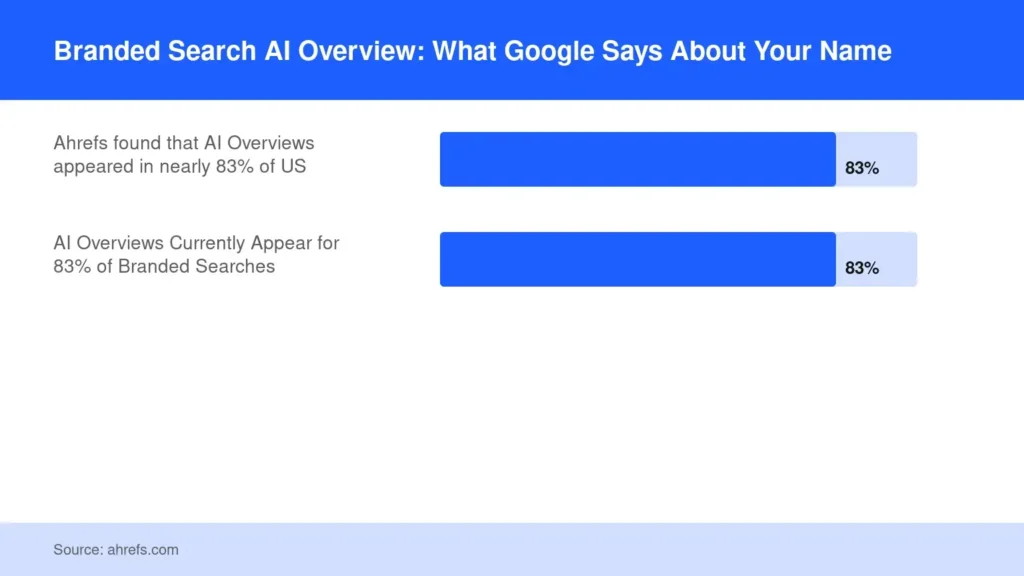
A branded search is any query that includes your name: the clinic name alone, or the name plus “hours”, “reviews” or “insurance”. Ahrefs found that AI Overviews appeared in nearly 83% of US desktop search results for branded keywords in one snapshot, and that most of those sat in the top position. That same study warned this could reduce clicks to brands’ own websites and give third-party sources a bigger say.
That is the loss worth naming plainly. It is not a penalty. It is simply that the first description of your practice may be written from other people’s pages.
Which sources does Google cite when it summarises your brand?
Google often cites big platforms rather than the business itself. In Ahrefs’ brand panel, Wikipedia, YouTube and LinkedIn were the most frequently cited outside domains in brand-name answers.
Search Engine Journal also noted a gap in that data: Ahrefs did not say how many cited pages belonged to the brands themselves. A practice has no Wikipedia entry, so its summary leans on whatever else exists: directories, review sites, an old news mention, a video someone else posted. One commentator Ahrefs quoted warned that videos cited in these answers “may very well include outdated product information.”
For a clinic, outdated information means old hours, a provider who left, or a service you stopped offering. None of those is a disaster on its own. Together, they describe a practice that no longer exists.
How do you run the branded search test on your own practice?
Open a private browser window, type your practice’s exact name, and read the summary before you scroll. Then work through this list and write each answer down.
- Name alone: does an overview appear, and does it describe what you actually treat?
- Name plus town: does it pick the right location if you have more than one?
- Name plus “reviews”, “hours” and “insurance”: these are the questions patients type before they call.
- The cited links: open each source and note whether it is your site, your Google Business Profile, a directory, or a page you have never seen.
- The errors: mark every sentence that is wrong, stale or vague.
- The gaps: list what is true about you that the summary never mentions.
Repeat the same queries from a phone, since mobile results can look different. Keep the list. It becomes your publishing plan, because each gap is a question your own site has not answered in writing yet.
What can you control directly in Google's answer?
You control two things directly: your Google Business Profile and the pages on your own website. Everything else you can only influence.
Google says a Business Profile lets you manage how your business shows up on Maps and Search at no charge, so fix hours, services and locations there first.
For your site, Google’s guidance on AI features and your website says the same SEO best practices apply: indexable pages, Search policies, and helpful, reliable, people-first content. There is no special markup for AI. Google also lists nosnippet and noindex as ways to limit what it shows, but hiding your pages only leaves the summary more dependent on everyone else.
Why do steady first-hand posts change what the summary says?
Steady, first-hand posts give the summary accurate facts that only your site holds, so Google has something better to quote than a stale directory. One post won’t do it; a habit will.
Google’s own guide to optimizing for generative AI features says its systems reach your data the same way Search finds and processes your pages. If the answer to a patient’s question lives only on a review site, that is where the overview goes to find it. Ahrefs’ study of brand visibility found that YouTube mentions showed the strongest correlation with AI Overview visibility, which tells you mentions across multiple places matter, not only one page.
What makes a post first-hand is a fact no competitor can copy: how your intake works, which conditions your team sees most, what changed when you added a location. Write those in the owner’s voice, link every figure to its source, and the summary has a reliable source with your name on it.
What did publishing on my own sites teach me about first-hand facts?
It taught me that first-hand facts decide whether a post should exist at all. A post with nothing only your practice could say is better left unpublished.
Every post goes through a review pass before it goes live, and a draft that cannot say two things only that business can say is set aside, not published.
On one of those sites, in a single week, the review set aside 9 of 14 drafts. The site’s facts held too little that only that business could say. That was a useful loss. It showed me the bottleneck for a branded summary is rarely writing time. It is the store of true, specific facts the owner has never put in writing.
Frequently asked questions
Do AI summaries reduce clicks to a practice website?
Yes, they can. Ahrefs warned that AI Overviews on branded searches could reduce clicks to brands’ own websites. For branded queries, that makes it more important that the summary itself describes your practice accurately, because some patients will decide from it.
Can I ask Google to remove a wrong AI Overview about my business?
Google offers a feedback option on AI Overviews, but there is no guaranteed removal. The more reliable path is to correct the underlying sources: update your Business Profile, fix directory listings you can edit, and publish a clear page on your own site that states the correct facts so Google has a better source.
What are the top AI search engines a practice should check?
Start with Google’s AI Overviews and AI Mode, since most patients already search there, then check ChatGPT and Microsoft Copilot. Ask each the same branded questions and compare the sources. Differences between them usually point to a fact that appears clearly on one platform and nowhere on your own site.
Is there an AI tool that can handle branding content for a practice?
Yes, several tools draft content, but the useful test is whether it writes from your practice’s own facts and voice. Ask whether every figure links to a source, whether drafts are reviewed before publishing, and whether a post with nothing specific to say gets held back rather than published to fill a schedule.
How should agencies track client brands in AI Overviews?
Agencies can run the same branded query list for each client on a regular schedule and log the cited sources over time. Paid tools such as Ahrefs Brand Radar filter AI responses by brand mention. A simple shared sheet of queries, citations and errors still works, and it becomes a useful content plan.
The Bottom Line
Type your practice’s name into Google today, read the summary, and write down every source it cites. Fix your Business Profile first. Then turn each gap on your list into a post on your own site, written from facts only your practice holds.
If finding the hours is the hard part, that is the job I built Blog & Social Posts, Done for You to do: it decides what to publish, writes it in your voice with sources linked, and publishes it. Try it.
Related on this site
- Google Preferred Sources: How a Practice Site Earns the Star
- Google Posts Local Panel Tests and What Your Practice Posts
Start free for 14 days
Sources
- AI Overviews Currently Appear for 83% of Branded Searches (Ahrefs)
- AI Overviews Have Spread To Most Big-Brand Searches (Search Engine Journal)
- Top Brand Visibility Factors in ChatGPT, AI Mode, and AI Overviews (Ahrefs)
- AI features and your website (Google Search Central)
- Optimizing your website for generative AI features on Google Search (Google Search Central)
- Get started with Google Business Profile (Google Business Profile Help)