Google Review Request Rules: Fix Your Front Desk Ask
Key takeaways
- Yes, a front desk script can break the google review request rules, and two of the most common habits in private practice now do: setting a review target for staff, and asking a patient or client to mention a team member by name.
- Google's policy expects a neutral ask with no steering toward a rating, no incentive in exchange for a review, no pressure to post on the premises and no instruction about what the review should say, and it lets Google remove reviews or restrict a Business Profile when a pattern of violations shows up.
Yes, a front desk script can break the google review request rules, and two of the most common habits in private practice now do: setting a review target for staff, and asking a patient or client to mention a team member by name. Google's policy expects a neutral ask with no steering toward a rating, no incentive in exchange for a review, no pressure to post on the premises and no instruction about what the review should say, and it lets Google remove reviews or restrict a Business Profile when a pattern of violations shows up. Asking is still allowed and still works; the script simply has to get out of the customer's way, and the slower levers that remain sit on your own website.
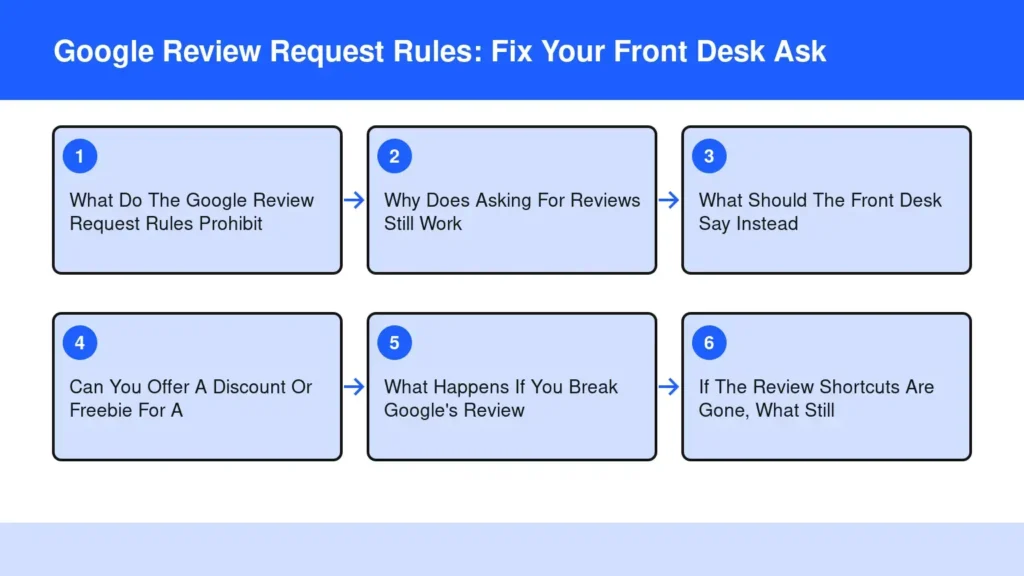
What Do The Google Review Request Rules Prohibit?
They prohibit any ask that shapes the outcome. No incentive in exchange for a review, no selectively soliciting the happy customers, no pressure to post while someone is still standing at the counter, no instruction about what the review should say, no review quota for staff, and no request that a customer name a specific employee.
The google review request rules sit inside Google’s prohibited and restricted content policy, which tells merchants not to offer incentives such as payment, discounts or free goods and services in exchange for posting a review or for revising or removing a negative one, not to discourage or prohibit negative reviews, and not to selectively solicit positive reviews. The same policy adds that when soliciting reviews, merchants should not require or pressure users to leave ratings or write reviews while on the premises, and should not request that specific content be included.
Two clauses in the rating manipulation section name the habits that spread fastest through independent practices, because for a while they worked. The policy bars “merchants requesting that staff solicit a certain number of reviews” and requests that staff solicit reviews containing specific content, including content that identifies a staff member. Read plainly, that puts a familiar list out of bounds:
- A monthly review target, a leaderboard or a bonus tied to how many reviews a team member brings in
- A script that asks the customer to mention the hygienist, the technician or the office manager by name
- A tablet or kiosk at checkout that keeps people on the premises until they post
- Any version of review gating, where you ask how the visit went first and send the Google link only to the people who answer well
- A discount, a free service or a prize drawing offered in exchange for a review, or for removing a negative one
Why Does Asking For Reviews Still Work?
Because the rules forbid steering, not asking. Google’s own guidance for businesses says to remind customers to leave reviews and to share a review link or QR code with them, so a neutral request is squarely inside policy and remains the most reliable way to grow a count of local Google reviews.
The reason a plain ask performs is boring and durable: most satisfied customers never think to review anyone. They had a good experience, they went back to their day, and nobody handed them the link. Google’s tips for getting more reviews point at exactly that gap, and the same page notes that customers must be signed into a Google Account to leave a review, which is a friction point a link or code removes rather than a reason to give up.
The other half is what you do after the review lands. Google requires a verified business before you can reply, and treats helpful, positive replies as a sign that you are responsive to customers in its guide to managing customer reviews. Replies are also the one piece of review activity entirely under your control, which is why they are worth ten minutes a week more than any staff contest ever was.
What Should The Front Desk Say Instead?
Say less, and hand over the link. A compliant request names no staff member, suggests no rating, sets no target and makes no offer. Three lines are enough:
- At the end of the visit: If you have a minute later, we would be grateful for a review on Google. I will text you the link.
- In the text or email that follows: Thanks for coming in today. Here is the link to review us on Google, and whatever you write is helpful.
- If they say no, or say nothing: nothing. No second ask at the desk, no tablet, no follow-up that mentions a rating.
Notice what is missing. There is no five stars, no mention my name, no let us know first if anything was less than perfect. The word whatever is doing real work in the second line: it invites honest feedback instead of filtering for positive feedback, which is the part the policy actually cares about. Sending the request after the visit rather than during it clears the on-the-premises problem without costing you a single review.
Then change the artefacts, because scripts live on paper. Take the quota column off the staff sheet, retire the counter card that names people, and move the review link into the follow-up message where it belongs. Then do the same audit online, because the desk answers the same questions twice: here are the front desk questions your website should answer first.
Can You Offer A Discount Or Freebie For A Google Review?
No. Offering free or discounted goods or services in exchange for customers posting reviews, changing reviews or removing negative reviews is treated as fake and misleading content and is strictly prohibited, according to Google’s page of tips for getting reviews. That covers the raffle, the gift card, the free upgrade and the account credit, whether the review that follows is positive or negative.
There is a second layer in the United States, and it has sharper teeth than a profile restriction. The Federal Trade Commission’s rule on consumer reviews and testimonials prohibits the sale and purchase of fake reviews and lets the agency seek civil penalties against knowing violators. The FTC’s own questions and answers on the rule note that the section covering compensated reviews applies to the business providing the incentive, not to the consumer who accepts it.
What works instead, without an offer: make the ask easy, make it routine, and make it part of closing out a visit rather than a campaign. A practice that asks every customer, every week, in the same neutral words will pass the practice that ran a contest for one quarter and then stopped.
What Happens If You Break Google's Review Policy?
Google’s review policy is enforced two ways: the offending reviews come down, and the Business Profile itself can be restricted. Its documentation on Business Profile restrictions for policy violations lists three consequences: the profile cannot receive new reviews or ratings for a set period, its existing reviews or ratings are unpublished for a set period, and the profile displays a warning letting consumers know that fake reviews were removed.
Sit with the second and third for a moment. A practice that spent years collecting genuine reviews can have the entire wall of them hidden because of a quota on a clipboard, and that public warning is visible to every person comparing you against two competitors on Maps. Google does allow a business to appeal, and says it will re-review the profile along with any additional context the business provides. It is a thin cushion to land on.
Agencies, You May Have Handed A Client The Problem
If you build sites or run local search for practices, the kiosk, the counter card, the training that told staff to ask for their own name and the review target in a monthly report were all standard deliverables until recently. Go and look at what is still live in your clients’ offices, because the restricted profile is theirs and the phone call is yours. The agency report and the partner program exist for that conversation.
If The Review Shortcuts Are Gone, What Still Builds Local Visibility?
Three things, and every one of them is slower than a review contest: published answers to the questions people actually ask you, replies to the reviews you already have, and visible evidence on your own site of how the practice works. None of them can be withdrawn by a policy update, because you own the asset.
That is the part owners find frustrating and the part that survives. Reviews are rented; a website is owned. Leave the owned side thin and you lose patients to competitor content you never published. The same gap decides whether an AI assistant can describe your service at all, and what practices must publish to get found by AI answer engines is a shorter list than most owners expect. Your week of phone calls is the raw material, and a call log content plan turns the questions you answered out loud into topics worth publishing.
I have spent my working life on the performance side of this: I was a strength and conditioning coach for the Toronto Blue Jays, the Tampa Bay Buccaneers and the University of South Florida, and I am co-founder and Chief of Human Performance at Functionised. I know how a front desk ends up with a review target on a clipboard, and I know why the website never gets written, because the owner is the bottleneck and the owner is busy. That is why I built a way to get blog and social posts done for you, so the publishing keeps happening on the weeks the owner never finds an hour. I have run it on my own four sites since September 2026, and the argument behind it is why your practice website content should stop waiting on you to write.
Frequently asked questions
Can I send a follow-up reminder if someone hasn't left a review yet?
Yes, one neutral reminder is fine, provided it does not mention a rating, name a staff member or offer anything in exchange. Google’s guidance for businesses encourages reminding customers and sharing a review link or QR code with them. Keep it to a single follow-up, send it after the visit, and stop there if the person does not respond.
Yes, one neutral reminder is fine, provided it does not mention a rating, name a staff member or offer anything in exchange. Google’s guidance for businesses encourages reminding customers and sharing a review link or QR code with them. Keep it to a single follow-up, send it after the visit, and stop there if the person does not respond.
Do customers need a Google account to leave a Google review?
Yes. Google says customers must be signed into a Google Account to leave a review, and that an account can be created with a non-Gmail address. Maps reviews are public and Google states you cannot add an anonymous review, so expect some people to decline for that reason alone.
Yes. Google says customers must be signed into a Google Account to leave a review, and that an account can be created with a non-Gmail address. Maps reviews are public and Google states you cannot add an anonymous review, so expect some people to decline for that reason alone.
What should I do if I get a negative review after asking for reviews?
Reply once in public, briefly, and move the specifics to a phone call. Do not pressure the reviewer to take it down, offer anything for its removal, or threaten them, because all three create exposure with Google and under United States review law. If the review breaks Google’s content policies, flag it instead of negotiating.
Reply once in public, briefly, and move the specifics to a phone call. Do not pressure the reviewer to take it down, offer anything for its removal, or threaten them, because all three create exposure with Google and under United States review law. If the review breaks Google’s content policies, flag it instead of negotiating.
Can I ask for reviews on platforms other than Google?
Yes, and each platform sets its own rules, so read them before you write the script. The neutral wording that satisfies Google’s policy will satisfy most of them, so run one script everywhere rather than one per site. What to avoid is sending different customers to different platforms based on how happy they seem, which is gating by another name.
Yes, and each platform sets its own rules, so read them before you write the script. The neutral wording that satisfies Google’s policy will satisfy most of them, so run one script everywhere rather than one per site. What to avoid is sending different customers to different platforms based on how happy they seem, which is gating by another name.
Can my employees write reviews of our own practice?
Not without disclosure, and it is seldom worth doing. The FTC rule on consumer reviews and testimonials covers insider reviews by officers, managers, employees, agents and immediate relatives, and the agency’s guidance warns that even disclosed insider reviews can break the law if they materially lift a star rating.
Not without disclosure, and it is seldom worth doing. The FTC rule on consumer reviews and testimonials covers insider reviews by officers, managers, employees, agents and immediate relatives, and the agency’s guidance warns that even disclosed insider reviews can break the law if they materially lift a star rating.
The Bottom Line
Rewrite the ask and the exposure disappears. Drop the staff target, drop the name, retire the kiosk, withdraw any offer, send one neutral link after the visit and reply to every review that arrives. That is the entire compliance job and it takes an afternoon. What it does not do is replace the visibility a review contest was quietly buying you, and that has to come from what you publish.
So the deferred decision comes back: what should the site answer next, and who is going to write it. Start with the report on what to publish next or the book, then get the writing off your own desk so it happens every week while you run the practice. The overview and the plans page set out the options, and help is there if you get stuck.
Start free for 14 days
Sources
- Prohibited & restricted content – Google Business Profile Help
- Tips to get more reviews – Google Business Profile Help
- Manage customer reviews – Google Business Profile Help
- Business Profile restrictions for policy violations – Google Business Profile Help
- Add, edit, or delete Google Maps reviews & ratings – Google Maps Help
- Federal Trade Commission Announces Final Rule Banning Fake Reviews and Testimonials
- The Consumer Reviews and Testimonials Rule: Questions and Answers – Federal Trade Commission
- Google tightens Maps review policy: staff names and quotas now banned – PPC Land