First Hand Experience Content: What Google Rewards Now
Key takeaways
- First hand experience content outranks templated posts because it carries evidence that a specific person did the work: decisions explained, figures linked to their sources, and a byline a reader can check.
- Pages assembled at scale with nothing added — interchangeable blog posts, spun service descriptions, bulk FAQ sets — have no such evidence, and neither does a blog that has gone quiet.
First hand experience content outranks templated posts because it carries evidence that a specific person did the work: decisions explained, figures linked to their sources, and a byline a reader can check. Pages assembled at scale with nothing added — interchangeable blog posts, spun service descriptions, bulk FAQ sets — have no such evidence, and neither does a blog that has gone quiet. For an independent practice the fix is not becoming a writer; it is making the owner visible on the page and keeping a rhythm you can hold.
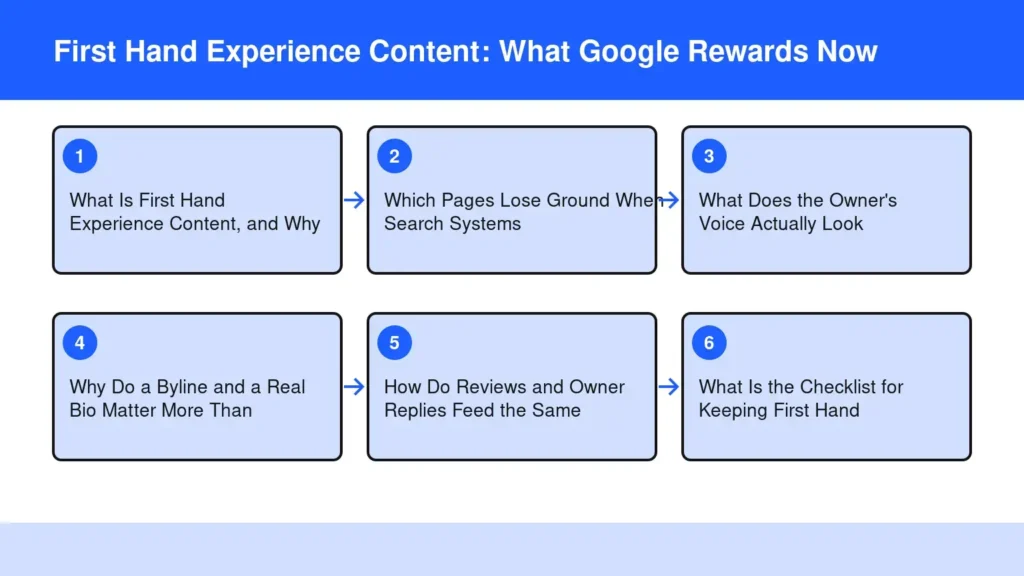
What Is First Hand Experience Content, and Why Does Search Reward It?
First hand experience content is writing that could only have come from someone who does the work — a page where the decisions, the trade-offs, the numbers and the sources all trace back to a named person with a reason to know. It is rewarded because search systems are built to find exactly that, and because readers can tell the difference almost immediately.
Google’s own self-assessment questions for publishers ask whether the content provides original information, reporting, research, or analysis, and whether it offers insight beyond the obvious rather than simply rewriting other sources. The quality rater guidelines go further and list, among the helpful purposes a page can have, to share a personal experience, perspective, or feelings on a topic. That is not a loophole for amateurs. It is the whole point.
The practical reading for a private practice is simple. Expertise is what your credentials say about you; experience is what your week says about you. A page that reports what you actually see in your own chairs, your own call log and your own results is a page no competitor and no content mill can produce, and it is the kind of page the engines keep looking for.
Which Pages Lose Ground When Search Systems Re-Weight Quality?
The pages that lose are the ones produced at scale with nothing added: templated blog posts that could carry any practice’s name, spun service descriptions, and bulk-generated FAQ pages written to catch keywords rather than answer people. Silence loses too, which is the part owners miss.
Google’s spam policies define scaled content abuse as many pages generated primarily to manipulate rankings and not to help users, and name using generative tools to produce many pages without adding value as an example. When that policy was introduced, Google was explicit that it applies no matter whether content is produced through automation, human efforts, or some combination. The method was never the issue; the absence of a person was. A drop after a broad update is not a punishment either — Google’s guidance on core updates and your website says the changes do not target specific pages, and that pages previously under-rewarded may start doing better.
So the exposed positions on a practice website look like this:
- Interchangeable posts — articles where swapping the business name changes nothing.
- Paraphrased pages — the same explanation every other site in town carries, lightly reworded.
- Answer pages at volume — FAQ sets built for coverage, with no front desk behind them.
- Unsigned content — no author, no bio, nothing a reader could check.
- An empty blog — the question gets answered by a competitor instead, which is why patients leave for content you never published.
What Does the Owner's Voice Actually Look Like on a Page?
It looks like specifics, sourced numbers, and decisions explained — imperfect prose from someone who obviously does the work, rather than smooth prose from nobody in particular. A few habits carry almost all of it.
Specifics. Not “we tailor treatment to each patient,” but the actual fork in the road: what you do when a new patient arrives with imaging from somewhere else, and why. Numbers with sources. Any figure about the outside world gets a link to the page it came from, in the sentence where it appears; any figure about your own practice gets stated as yours. Decisions explained. Readers trust a reason more than a result, and so do the systems reading for original analysis. Attribution. One name on the post, leading to a bio that says why that name belongs there.
That is unglamorous, occasionally blunt, and impossible to fake — which is exactly the quality search engines are now sorting for. If your own site is still waiting for you to find an afternoon, the problem is capacity, not ability: your content should stop waiting on you to write.
Why Do a Byline and a Real Bio Matter More Than Polish?
Because a byline is how a reader — and a rating system — answers the question of who is responsible for the page. Polish is cheap now. Accountability is not.
Google’s publisher guidance asks whether it is self-evident who authored your content, whether pages carry a byline where one would be expected, and whether that byline leads to further information about the author and the areas they write about. The same page warns that fabricating creator profiles — invented names, generated headshots, false credentials — is a form of deception and a signal of a low-quality page. An absent author and a fake author are both worse than a plain one.
A real bio does not need to be impressive, only true and checkable. Mine mentions that I am co-founder and Chief of Human Performance at Functionised, that I made The Keto Project, and that I wrote 600 Burgers in 30 Days and The Longevity Trinity. For a practice owner the equivalent is a line or two: what you treat, how long you have done it, and the letters after your name. Put it under every post and link it to a page that stands behind it.
How Do Reviews and Owner Replies Feed the Same Shift Locally?
The local half of search rewards the same visible owner. A profile with fresh reviews and replies written by a person reads as a live business; one whose newest review is months old and whose replies stopped reads as absent.
Google’s own tips for local ranking are blunt about the mechanics: keep your business information complete and accurate, verify your locations, and respond to reviews, because positive reviews and helpful replies can help your business stand out. The same page states there is no way to request or pay for a better local ranking, which is good news for an independent practice and bad news for anyone hoping to buy their way past attention.
Treat the two halves as one job. The questions your front desk fields become pages, and the pages become the answers Maps and the AI engines quote back; the replies you write make the profile look staffed by humans. If you want the publishing side of that in order, start with the questions your front desk already answers, then make sure those answers exist where AI answer engines can find them.
What Is the Checklist for Keeping First Hand Experience Content in Every Post?
Run every post through these checks before it publishes. None of them require you to become a writer; they require you to be identifiable.
- One named author, with a bio that links to credentials a reader can verify.
- One decision explained that only someone doing the work would know to mention.
- Every outside figure linked to the page it came from, in the sentence where it appears.
- Specifics over adjectives — a real example beats “comprehensive” and “state-of-the-art” every time.
- Questions you are actually asked, in the words people use to ask them.
- Nothing interchangeable: if a competitor could run the post unchanged, rewrite it or drop it.
- A publishing rhythm you can keep without heroics, because consistency is what compounds.
That last one is where practices stall. Blog & Social Posts, Done for You was the first app: it decides what to publish, writes it in your voice with every figure linked to its source, publishes it and shares it. It has run on my own four sites since September 2026 — I am the first customer. If you would rather read the argument first, the book covers what search and AI reward now.
Frequently asked questions
Can I use AI to help write posts and still show first-hand experience?
Yes, as long as the experience in the post is genuinely yours. Google’s guidance is that automation is a problem when the primary purpose is manipulating rankings rather than helping people. A draft built from your own decisions, your own figures and your own sources, reviewed by you before it publishes, is still your content.
Yes, as long as the experience in the post is genuinely yours. Google’s guidance is that automation is a problem when the primary purpose is manipulating rankings rather than helping people. A draft built from your own decisions, your own figures and your own sources, reviewed by you before it publishes, is still your content.
Should I disclose that automation helped produce an article?
Disclose it where a reader would reasonably wonder how the page was made. Google’s guidance on who, how and why asks you to be open about how a page was produced, in the places a reader would reasonably look for it. Keep the byline on the person whose judgement and experience the article reflects.
Disclose it where a reader would reasonably wonder how the page was made. Google’s guidance on who, how and why asks you to be open about how a page was produced, in the places a reader would reasonably look for it. Keep the byline on the person whose judgement and experience the article reflects.
How many pages does a practice need before the owner's voice counts?
Fewer than most owners assume. One page that explains a real decision, with the figures sourced, does more than a shelf of interchangeable service pages. Volume only helps once each page adds something the others do not, which is the test Google’s self-assessment questions are built around.
Fewer than most owners assume. One page that explains a real decision, with the figures sourced, does more than a shelf of interchangeable service pages. Volume only helps once each page adds something the others do not, which is the test Google’s self-assessment questions are built around.
Do FAQ pages still help, or should I delete mine?
Keep the ones that answer questions people actually ask you, and consolidate the rest. The problem was never the format; it was generating many near-identical answer pages at scale. An FAQ written from your own front desk log, in your words, is a different object entirely.
Keep the ones that answer questions people actually ask you, and consolidate the rest. The problem was never the format; it was generating many near-identical answer pages at scale. An FAQ written from your own front desk log, in your words, is a different object entirely.
Can an agency publish in a client's voice without faking it?
Yes, if the client’s specifics drive the draft and the client’s name carries the byline. The agency’s job is interviewing, sourcing and scheduling, not inventing an owner’s experience. Fabricated credentials or made-up author profiles are treated as deception, so the person named has to be real and really involved.
Yes, if the client’s specifics drive the draft and the client’s name carries the byline. The agency’s job is interviewing, sourcing and scheduling, not inventing an owner’s experience. Fabricated credentials or made-up author profiles are treated as deception, so the person named has to be real and really involved.
The Bottom Line
Nothing about this shift is hostile to a small practice. It is hostile to a factory. The sites that held ground are the ones where a reader can see a person — a byline, a bio, a decision explained, a figure that points to its source — and the sites that slid are the ones where anyone could have written anything. Your advantage is that you do the work; the only gap is the hours between knowing that and publishing it.
So pick the next question a patient asked you, answer it in your own words, sign it, and link anything you quote. Then do it again next week. If finding those hours is the part that never happens, let the free report show you what to publish next, and then let the publishing side hold the schedule while you see patients.
Start free for 14 days
Sources
- Creating Helpful, Reliable, People-First Content — Google Search Central
- Spam Policies for Google Web Search
- What web creators should know about our March 2024 core update and new spam policies
- Google Search's core updates and your website
- Search Quality Rater Guidelines: General Guidelines (PDF)
- Tips to improve your local ranking on Google — Google Business Profile Help