Google AI Contribution Pilot: What It Means for Your Site
Key takeaways
- The google ai contribution pilot is a small, invite-only Search Console test where Google pays some publishers when their content contributes significantly to answers in Gemini, AI Overviews and AI Mode.
- It pays at the point the answer is generated, not for links shown afterwards, so no private practice should expect a cheque from it.
The google ai contribution pilot is a small, invite-only Search Console test where Google pays some publishers when their content contributes significantly to answers in Gemini, AI Overviews and AI Mode. It pays at the point the answer is generated, not for links shown afterwards, so no private practice should expect a cheque from it. The useful part is what Google says it values: content that adds freshness and factuality through grounding. That gives you a test you can run on your own pages.
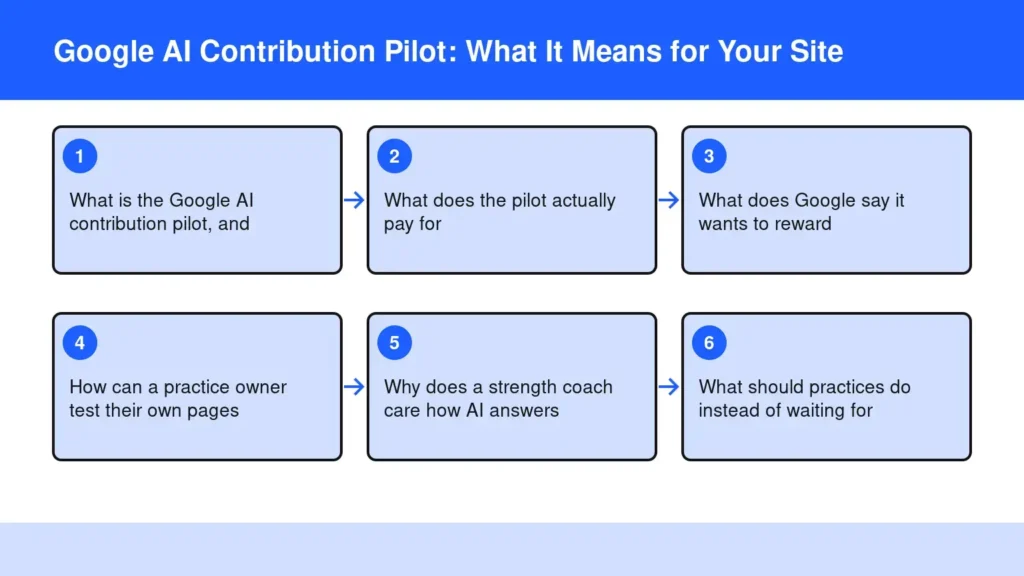
What is the Google AI contribution pilot, and who got in?
The google ai contribution pilot is an early Google test that pays invited publishers through Search Console when their pages shape an AI-generated answer. Only a limited group was invited, and you can’t apply to join.
Semrush reports that Digiday broke the story on September 14, and that Barry Schwartz had spotted the feature in Search Console in April, before anyone knew money was involved. Search Engine Journal says at least dozens of publishers were approached, though nobody has confirmed the total. The same report says participants see a monthly earnings figure and can opt out at any time.
Search Engine Land describes AI contribution as a Search Console feature that Google is testing with a limited number of publishers. As far as the reporting shows, the invited sites are publishers, not small or mid-sized local businesses.
What does the pilot actually pay for?
The pilot pays when content shapes the answer at the moment it is generated. Being linked or cited afterwards doesn’t count.
Google’s help documentation, shown in Digiday’s screenshots, says pages linked in a response don’t qualify, and neither do pages used to confirm a fact after the answer is written. Google hasn’t said how it decides what counts as significant, or how it works out a payout.
The early money looks thin. One source told reporters the returns so far were “peanuts” next to ad revenue. The same piece notes that the AI performance reports, which reached all sites on Aug. 31, show impressions but not clicks. For a practice, the cheque doesn’t matter. What matters is the definition of the work Google is willing to pay for.
What does Google say it wants to reward?
Google says it wants content that adds freshness and factuality to AI answers through grounding. Grounding means the model checks its answer against real pages instead of relying only on what it learned in training.
In a June 18 post, Google said it was piloting a new way to partner with websites whose content meaningfully contributes to the “freshness and factuality” of generative AI responses. That is the clearest statement Google has made so far about what kind of page shapes an AI answer. It reads less like a technical trick and more like a description of good reporting.
Google’s own guidance for site owners points the same way. Its page on AI features and your website describes AI Mode as built for questions that need more reasoning and comparison. A vague page that says what every other site says gives the model nothing to ground on. I cover the file side of this in llms txt AI Search.
How can a practice owner test their own pages?
Open your five most-visited pages and ask four questions of each. A page that fails two or more has little that would ground an AI answer.
- Is it dated? A visible published or updated date tells a reader, and a model, whether the page is still true.
- Is it specific? It should name the condition, the visit, the insurance question or the town, and not just talk about “quality care”.
- Is it sourced? Every figure should link to the page it came from, in the same sentence.
- Is it written by someone who treats patients? A real name and real credentials on the byline, and detail that only a clinician would know.
The fourth question is the one most sites fail. I explain why in First Hand Experience Content. If you aren’t sure which pages to start with, the questions your front desk hears every day are the best list. See Front Desk Questions Website Pages Should Answer First.
Then check the result in your own data. Search Console AI impressions show whether those pages are being surfaced at all.
Why does a strength coach care how AI answers are grounded?
Because I’ve spent my working life where a wrong number has consequences. I was a strength and conditioning coach for the Toronto Blue Jays, the Tampa Bay Buccaneers and the University of South Florida. I hold the NBCE and CSCS credentials.
In that work, a programme you can’t trace back to evidence doesn’t get used. The same standard is now how AI answers choose what to trust: dated, specific, sourced, written by someone who does the work. Practice owners already meet that standard in the treatment room. Most just never get it onto the website.
I hold my own four sites to the same standard. A post that sounds like you but cites nothing doesn’t pass the test above. Neither does a sourced post that sounds like nobody.
What should practices do instead of waiting for an invite?
Publish pages that pass the four-question test, on a steady schedule, and stop worrying about the pilot. The payment is for large publishers. The standard behind it applies to everyone.
Silence costs you more than any cheque would pay. A patient’s question still gets answered. If you haven’t answered it in writing, the answer comes from the practice down the road that has. I wrote about that cost in Why You Are Losing Patients To Competitor Content You Never Published.
The hard part for most owners is time, not knowledge. That is the problem a tool in this category has to solve without flattening your voice, which I wrote about in Your Practice Website Content Should Stop Waiting on You to Write.
Frequently asked questions
What AI services does Google offer in Search?
In Search, Google’s main AI features are AI Overviews and AI Mode, alongside the separate Gemini app. AI Overviews give a summary above the results. AI Mode handles longer back-and-forth questions, and Google’s help pages describe moving from an overview into AI Mode to dig deeper. All three take part in the payment pilot.
In Search, Google’s main AI features are AI Overviews and AI Mode, alongside the separate Gemini app. AI Overviews give a summary above the results. AI Mode handles longer back-and-forth questions, and Google’s help pages describe moving from an overview into AI Mode to dig deeper. All three take part in the payment pilot.
Can I turn off AI in my Google searches?
No, there is no permanent switch, but you can hide AI Overviews one search at a time. Select the Web filter under the search box and Google reloads the results as plain links. Search Engine Watch explains that Google treats AI Overviews as a core feature of Search, so turning off a Search Labs experiment won’t remove them.
No, there is no permanent switch, but you can hide AI Overviews one search at a time. Select the Web filter under the search box and Google reloads the results as plain links. Search Engine Watch explains that Google treats AI Overviews as a core feature of Search, so turning off a Search Labs experiment won’t remove them.
What AI company did Google buy?
Google’s best-known AI acquisition is DeepMind, the London research lab. CBS News reported the purchase in January 2014. DeepMind now leads much of Google’s AI research, including the Gemini models behind AI Overviews and AI Mode. That is part of why Google’s own AI is now built so deeply into Search.
Google’s best-known AI acquisition is DeepMind, the London research lab. CBS News reported the purchase in January 2014. DeepMind now leads much of Google’s AI research, including the Gemini models behind AI Overviews and AI Mode. That is part of why Google’s own AI is now built so deeply into Search.
Does joining the pilot change a site's rankings or visibility?
Google hasn’t said that it does, and none of the reporting I’ve read shows any effect on rankings. The pilot is described as a payment test that sits on top of the traffic and tools Google already provides. If your practice wasn’t invited, nothing changes for you, and you have no settings to change.
Google hasn’t said that it does, and none of the reporting I’ve read shows any effect on rankings. The pilot is described as a payment test that sits on top of the traffic and tools Google already provides. If your practice wasn’t invited, nothing changes for you, and you have no settings to change.
The Bottom Line
The pilot pays only a small group of publishers, and no practice should plan around it. What it tells you is worth more than the payment: Google wants AI answers grounded in pages that are dated, specific, sourced and written by people who do the work. Run the four-question test on your top pages this week, and fix the ones that fail.
Blog & Social Posts, Done for You decides what to publish, writes in your voice, links every figure to its source, and publishes and shares it for you. Try it.
Start free for 14 days
Sources
- Google's AI contribution pilot pays publishers (Semrush)
- Google Tests Paying Publishers For AI Answers Via Search Console (Search Engine Journal)
- Google tests paying publishers for using its content in AI Mode, AI Overviews and Gemini (Search Engine Land)
- AI Features and Your Website (Google Search Central)
- How to turn off Google AI Overviews and get normal search results back (Search Engine Watch)
- Google buys artificial intelligence startup DeepMind (CBS News)