Front Desk Questions Website Pages Should Answer First
Key takeaways
- The front desk questions website pages leave unanswered do not disappear; they get routed to a person you pay by the hour.
- Insurance accepted, walk-in availability, what a first visit involves, self-pay ranges and parking are the five your office is asked all day, and each is a paragraph the site could publish once.
The front desk questions website pages leave unanswered do not disappear; they get routed to a person you pay by the hour. Insurance accepted, walk-in availability, what a first visit involves, self-pay ranges and parking are the five your office is asked all day, and each is a paragraph the site could publish once. Treat that as a labor cost and a lost-lead problem, not a content gap.
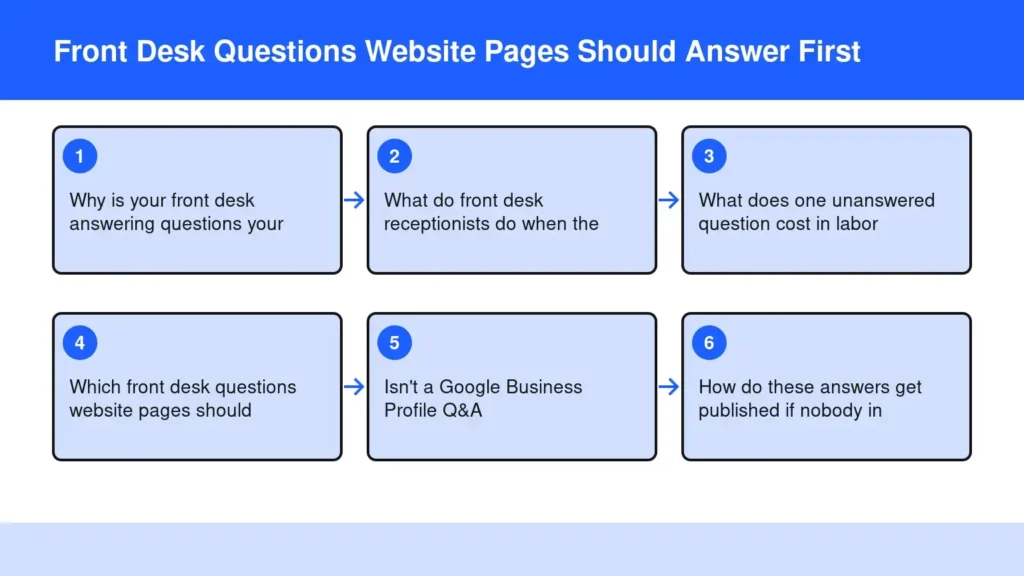
Why is your front desk answering questions your website should have answered?
Because nobody published the answer, so the phone is the only place it exists. A person who wants to know whether you take their plan has two ways to find out: read it on your page, or make a human tell them. When the page is silent, the front desk questions website visitors came to settle land on a headset instead.
The question does not evaporate when your site skips it. It gets routed. Some routes to your office, where a receptionist answers the same thing for the ninth time before lunch. The rest routes to whichever competitor’s page said it plainly, and that loss never shows up in a call log. You never get a missed call to review; you simply never hear from the person.
This is not the usual complaint about practice website content nobody has time to write. Here the content already exists. Your staff says it out loud every day; it was never written down where a search engine could read it.
What do front desk receptionists do when the website says nothing?
They become the search engine for your practice. The role is already full: the U.S. Bureau of Labor Statistics describes receptionists as workers who do tasks such as answering phones, receiving visitors, and providing information about their organization to the public. Unpublished answers add a second job on top of that one.
The duties BLS lists for general office clerks follow the same shape: answer telephone calls, take messages, schedule appointments, provide general information to staff, clients, or the public. All of that is real work. Repeating your parking instructions forty times a week is not; it is a website’s job that walked into the building.
Search this topic and most of what surfaces is interview questions for hiring a receptionist: how a candidate would describe handling an upset customer, what software they have used, which customer service experience and communication skills they bring to the position. Good questions when you are filling a key seat. None of them reduce the calls the seat has to handle.
What does one unanswered question cost in labor and lost leads?
It costs paid minutes you can measure and a lead you cannot. The labor side is public: BLS put the median wage for receptionists and information clerks at $17.23 an hour in May 2023, across 1,003,820 people employed in the occupation, and the median annual pay for receptionists at $38,010 in May 2025. That is the rate at which a company buys answers it could have typed once.
The lost-lead side is worse, because it is silent. Pew Research Center tracked real browsing and found that 58% of respondents ran at least one Google search in March 2025 that produced an AI summary, and users who saw a summary clicked a traditional result link in 8% of visits against 15% for those who did not, while only 1% clicked a link inside the summary.
The sentence that answers the question is now the asset, not the click. If your site never states that you accept a given plan, there is nothing of yours for an answer engine to lift, and the searcher gets somebody else’s sentence while your phone rings.
Which front desk questions website pages should answer first?
Start with the five your staff repeats most, in the specific words people use. This is the checklist I would hand an office manager on a Monday morning:
- Which insurance do you accept? Name the carriers, say what happens out of network, and say whether you provide a superbill.
- Can I walk in today? State the hours walk-ins are genuinely possible, and when they are not.
- What happens at a first visit? How long it runs, what to bring, who the person will see, what they leave with.
- What does it cost without insurance? Ranges belong in public. Under the No Surprises Act, providers and facilities must give uninsured or self-pay individuals a good faith estimate when care is scheduled or on request, so the conversation is coming either way.
- Where do I park and which door? Lot, street, suite number, the entrance that is not obvious from the road.
Ask your front desk which of those five came up most last week and publish that one first; a tally beats guessing. Each item is one short page, not a project, and each retires a call permanently.
Isn't a Google Business Profile Q&A enough for this?
No, it helps, but it is a summary and not the source. Owners and managers can answer questions in the Q&A section of their Business Profile, and the same help page caps a profile description at 750 characters. That is a signpost, not an explanation of a first appointment.
Google says local results are mainly based on relevance, distance and prominence, and that complete, detailed business info helps it match you to relevant searches. Complete info lives on your site; Maps points at it. A profile field cannot carry the paragraph that makes a nervous first-time caller book.
On the site side, Google has supported FAQPage structured data for official questions and answers since 2019, and requires that structured data be a true representation of the page content. Write the real answer in plain words first, and the markup has something honest to describe.
How do these answers get published if nobody in the office wants to write?
By making it a decision instead of a writing project. Pick one question on Monday, say the answer out loud the way you say it at the counter, have whoever types fastest put it into a page, and post it that week. Your part is choosing the question and confirming the wording sounds like the practice; nobody has to turn into a writer.
I am co-founder and Chief of Human Performance at Functionised, which runs FIT Clinic, FIT Lab and FIT Stretch in Colts Neck, Tinton Falls and Seabrook. Three locations is the clearest example I know of how this compounds: three sets of hours, three sets of directions, three first-visit explanations, one front desk culture absorbing all of it.
Three locations, five questions each, one published a week, and the list is finished inside a month. Start with whichever answer your staff is most tired of repeating, and work down the tally from there.
Frequently asked questions
How do I find out which questions people already ask my practice?
Ask the front desk to keep a tally for one week, then compare it with Search Console queries and the questions posted on your Business Profile. The overlap is your publishing order. Staff hear the emotional version of a question while searchers type the short version, so capturing both gives you the wording to use on the page.
Ask the front desk to keep a tally for one week, then compare it with Search Console queries and the questions posted on your Business Profile. The overlap is your publishing order. Staff hear the emotional version of a question while searchers type the short version, so capturing both gives you the wording to use on the page.
Should the answers be one FAQ page or separate posts?
Give each substantial question its own page and reserve the FAQ block for short, factual items. A first-visit explanation deserves room to breathe and can rank on its own; parking and hours are two lines each and belong grouped. One giant page tends to bury the specific answer a searcher wanted.
Give each substantial question its own page and reserve the FAQ block for short, factual items. A first-visit explanation deserves room to breathe and can rank on its own; parking and hours are two lines each and belong grouped. One giant page tends to bury the specific answer a searcher wanted.
What do I do about answers that change, like hours or accepted plans?
Write them in a way that survives revision and put a review date in your own calendar, not on the page. Avoid promising anything you cannot keep current. If a detail changes monthly, publish the stable part and tell people the single place to confirm the rest, so the page never goes stale in public.
Write them in a way that survives revision and put a review date in your own calendar, not on the page. Avoid promising anything you cannot keep current. If a detail changes monthly, publish the stable part and tell people the single place to confirm the rest, so the page never goes stale in public.
Will publishing these answers mean fewer patients calling?
It usually means fewer low-value calls and more booked ones. People who only wanted your parking instructions stop calling. People who read what a first visit involves call ready to schedule, which shortens the conversation and shifts your front desk from answering to converting.
It usually means fewer low-value calls and more booked ones. People who only wanted your parking instructions stop calling. People who read what a first visit involves call ready to schedule, which shortens the conversation and shifts your front desk from answering to converting.
Who should own this work in a small office, the owner or the office manager?
The office manager should own the question list, because they hear it; the owner should own the voice. That split works because nobody has to become a writer. The manager says which question came up most this week, the owner confirms the answer sounds like the practice, and publishing happens on schedule.
The office manager should own the question list, because they hear it; the owner should own the voice. That split works because nobody has to become a writer. The manager says which question came up most this week, the owner confirms the answer sounds like the practice, and publishing happens on schedule.
The Bottom Line
Your front desk is not failing. It is covering for a website that never spoke. Every question it answers twice a day is a page you have not published, and every searcher who wanted that answer found it somewhere else. Naming the five questions costs one conversation with your office manager; leaving them unpublished costs staff time and quiet losses, month after month, as you plan the next round of patient acquisition.
So work in this order: list what the phone asks, decide which one goes next, publish it in your own voice, then do it again the following week. Repeating it is the part nobody in a busy practice ever gets to, and it is the part that finally changes what the phone sounds like.
Related on this site
Start free for 14 days
Sources
- Office and Administrative Support Occupations, Occupational Outlook Handbook, U.S. Bureau of Labor Statistics
- General Office Clerks, Occupational Outlook Handbook, U.S. Bureau of Labor Statistics
- Occupational Employment and Wages, May 2023: 43-4171 Receptionists and Information Clerks
- Google users are less likely to click on links when an AI summary appears in the results, Pew Research Center
- Edit your Business Profile, Google Business Profile Help
- Tips to improve your local ranking on Google, Google Business Profile Help
- Requirements Related to Surprise Billing; Part II Interim Final Rule with Comment Period, CMS
- New in structured data: FAQ and How-to, Google Search Central Blog
- General Structured Data Guidelines, Google Search Central