AI Content Spam Update: What Practice Owners Check First
Key takeaways
- The dividing line in the AI content spam update is not whether a machine helped write the page.
- Google's published spam policy turns on purpose: pages generated in bulk mainly to move rankings are the target, and a page written for a real reader is not, however it was produced.
The dividing line in the AI content spam update is not whether a machine helped write the page. Google's published spam policy turns on purpose: pages generated in bulk mainly to move rankings are the target, and a page written for a real reader is not, however it was produced. For an independent practice, that means the risk is not AI assistance — it is publishing a stack of pages nobody asked for, with no sources attached and nothing true about your practice in them.
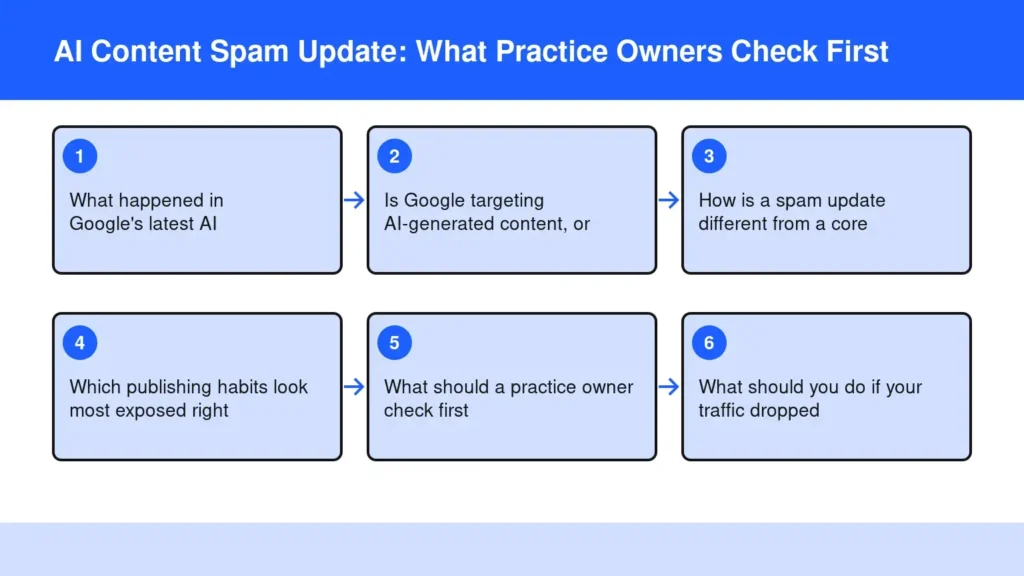
What happened in Google's latest AI content spam update?
Google started a new spam update on 24 September 2026, and it is the fourth of the year. Search Engine Journal reports that the rollout began at 9:15 a.m. PDT, applies globally and to all languages, and follows spam updates in March, June and August. Justia’s legal marketing team logged the same launch date and the same count of confirmed spam updates for 2026.
What makes it feel different is the August update that came before it. Agency write-ups after August argued that the sites hit hardest were the ones mass producing AI text. That reading is plausible, not official: one roundup of the September release separates what Google confirmed, which is the date, the global scope and the effect on ranking systems, from what it did not, including AI-generated content as a standalone target.
So the honest summary is this: something is moving across sites that published automated pages in bulk, and Google has not named AI as the reason. The policy it has named is older and more specific, and it is worth reading before you touch anything.
Is Google targeting AI-generated content, or something else?
Google is targeting purpose, not tooling. The spam policy that matters here is scaled content abuse, which Google’s own documentation defines as many pages generated for the primary purpose of manipulating search rankings rather than helping users, no matter how they are created.
That last clause is the whole argument. When Google introduced the updated policy it said plainly that automation, including generative AI, is spam if the primary purpose is manipulating ranking in Search results — and that the same practice carried out by a room of underpaid writers was always spam too. Earlier, in its guidance on AI-generated content, Google said its ranking systems aim to reward original, high-quality content that shows experience, expertise, authoritativeness and trustworthiness, however it is produced.
Read those two together and the line is clear. A page written with machine help, about something you genuinely do, for a question somebody genuinely asks, is not the problem. A thousand pages assembled because a tool could make a thousand pages is.
How is a spam update different from a core update?
A spam update tunes the systems that enforce published rules; a core update re-weighs how useful Google thinks your content is in the first place. The distinction matters because the fix is different.
The rules a spam update enforces are not secret. Google lists them in one place — scaled content abuse, link spam, expired domain abuse and the rest — and describes spam as techniques used to deceive users or manipulate its systems, including its generative AI answers. If you drop during a spam update, the first question is which of those named behaviours your site could be read as doing, including behaviours a previous vendor left behind.
A core update asks a softer question: compared with everything else on the topic, is your page the better answer? There is no rule to point at, which is why those recoveries are slow. One update demands you stop doing something. The other demands you become worth reading.
Which publishing habits look most exposed right now?
The exposed habit is volume without a decision behind it. A stack of near-identical service pages, each one a template with a city name swapped in, was never answering anybody — and that is the pattern a spam update is designed to find.
I spent years as a strength and conditioning coach for the Toronto Blue Jays, the Tampa Bay Buccaneers and the University of South Florida. Nobody ever got stronger by adding reps to a bad program. Volume amplifies whatever the program already is, which is exactly what happened to the sites that bought bulk content: they scaled a thing that had no reason to exist.
- Exposed: pages nobody searched for, written to fill a quota, with no figure sourced and no detail that could only come from your practice.
- Exposed: the same three paragraphs rotated across page after page with a different procedure name on top.
- Durable: one researched post a week that answers a question your front desk actually hears on the phone, in your voice, with every number linked to where it came from.
- Durable: posts that say something true and specific about how your practice works, which no competitor can copy without lying.
What should a practice owner check first?
Check what is already published under your name before you check your rankings. Most practice owners have never read the pages an old agency left behind on their site.
- Crawl your own site and count the pages. If the number surprises you, that is your first finding.
- Read a handful of pages at random. Ask whether a patient would recognise your practice in them.
- Find the figures. Any statistic without a link to its source is a liability on a health or legal site.
- Look for templates. Same structure, same sentences, swapped nouns — that is the signature an automated system looks for.
- Check the cadence. A burst of pages in one month followed by silence reads as a campaign, not a practice, and consistency is a signal in itself.
- Check your Search Console data for which of those pages has ever been seen by anyone at all.
Most of what you delete after this exercise, nobody will miss. That is the point: it was never written for a reader.
What should you do if your traffic dropped after the update?
Wait for the rollout to finish before you draw conclusions, then diagnose rather than demolish. Google gave the September release a rollout window of up to two weeks, where the three earlier spam updates of 2026 each finished inside two days and sixteen hours, so mid-rollout numbers are noise.
When it settles, separate the pages that lost from the pages that held. If the losers are the templated bulk and the holders are the few real posts, you have your answer and your plan: remove the filler, keep writing the real thing. If a page you are proud of lost, that is usually a competitor who published a better answer, not a penalty — and that gap is the one that quietly moves patients to the practice down the road.
Then do the harder thing: start publishing on purpose. A site that has gone quiet cannot prove anything to a ranking system, and recovery is mostly evidence.
Frequently asked questions
Should I delete my old thin pages or rewrite them?
Rewrite the ones a real person would search for, and remove the ones that exist only to hold a keyword. The test is whether the page answers a question somebody actually asks your front desk. If it does, give it a source, a real detail from your practice and a date. If it does not, it is not worth saving.
Rewrite the ones a real person would search for, and remove the ones that exist only to hold a keyword. The test is whether the page answers a question somebody actually asks your front desk. If it does, give it a source, a real detail from your practice and a date. If it does not, it is not worth saving.
Does publishing less often keep me safe from a spam update?
No. Silence protects nobody, because the questions your patients type get answered by whichever practice wrote something first. The safe position is not fewer pages, it is pages with a reason to exist. A steady, small cadence of sourced posts is easier to defend than a burst of filler followed by months of nothing.
No. Silence protects nobody, because the questions your patients type get answered by whichever practice wrote something first. The safe position is not fewer pages, it is pages with a reason to exist. A steady, small cadence of sourced posts is easier to defend than a burst of filler followed by months of nothing.
What does it actually mean to source a figure in a blog post?
It means the sentence containing the number carries a link to the page the number came from, not to a blog repeating it. A statistic sitting on its own is a claim a reader has to take on faith, and an answer engine has no way to verify it. Link the original, and let the reader check you.
It means the sentence containing the number carries a link to the page the number came from, not to a blog repeating it. A statistic sitting on its own is a claim a reader has to take on faith, and an answer engine has no way to verify it. Link the original, and let the reader check you.
How do I tell whether a content vendor is selling me volume?
Ask three questions: what decides the topic, whose voice writes it, and where do the sources go. A vendor selling volume answers with page counts and turnaround times. A vendor selling publishing answers with the question being addressed, the way your practice talks and the link under every figure. The second one survives updates.
Ask three questions: what decides the topic, whose voice writes it, and where do the sources go. A vendor selling volume answers with page counts and turnaround times. A vendor selling publishing answers with the question being addressed, the way your practice talks and the link under every figure. The second one survives updates.
Can my office manager run this instead of me?
Yes, and in most independent practices that is who should. The owner’s job is the voice and the judgment calls: how you explain a procedure, what you refuse to promise, the phrase you always use. The office manager supplies the questions coming over the phone and approves what goes out.
Yes, and in most independent practices that is who should. The owner’s job is the voice and the judgment calls: how you explain a procedure, what you refuse to promise, the phrase you always use. The office manager supplies the questions coming over the phone and approves what goes out.
The Bottom Line
This update is not a verdict on machines helping to write. It is a verdict on publishing without deciding. Volume was never the product. It has been running on my own four sites since September 2026, which is how I know the difference between a week of real publishing and a week of filler.
If an agency once filled your site with pages nobody asked for, the repair is not more pages — it is one honest, sourced post at a time, in your own words, every week, until the questions your patients type have your answer under them. The book covers what search and AI reward now and why the next article should be decided before it is written. Then try it: Blog and Social Posts, Done for You.
Start free for 14 days
Sources
- Google Spam Update, Image Search Data In GSC – SEO Pulse
- Google's September 2026 Spam Update Is Now Rolling Out
- September 2026 Google Spam Update: SEO Impact & Action Guide
- Google August Spam Update Targeted AI Content
- Spam Policies for Google Web Search
- What web creators should know about our March 2024 core update and new spam policies
- Google Search's guidance about AI-generated content