Get Found by AI Answer Engines: What Practices Must Publish
Key takeaways
- To get found by AI answer engines, your site has to publish original, sourced material on a schedule.
- Your practice website doesn't show up in ChatGPT or Google's AI Overview because those systems quote pages that answer a specific question.
To get found by AI answer engines, your site has to publish original, sourced material on a schedule. Your practice website doesn't show up in ChatGPT or Google's AI Overview because those systems quote pages that answer a specific question. A homepage plus five service pages answers almost none of them. So there is nothing recent and quotable for the machine to pull. This is a structural gap, not a design problem. The best-looking site in your county still loses to the one that publishes.
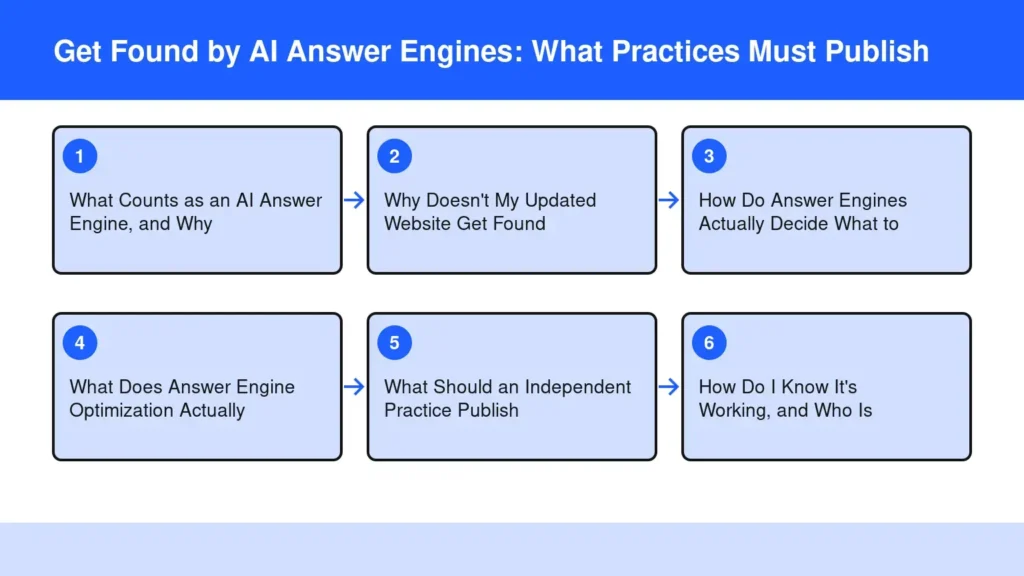
What Counts as an AI Answer Engine, and Why Should an Owner Care?
An answer engine is any tool that reads the web and delivers one composed answer instead of a list of ten links. ChatGPT, Google’s AI Overview and AI Mode, Perplexity, and the assistants built into phones and browsers all count. You should care because patients now ask machines first. You only get found by AI answer engines if one of them decides to cite you.
These tools search on your behalf. OpenAI’s documentation says ChatGPT can turn a request into one or more search queries, retrieve relevant results, and generate an answer with links to sources. OpenAI also describes chats that include links to sources, opened from a Sources button below the response. The citation is the new front door.
Pew Research Center reports that about half of U.S. adults now use AI chatbots, up from a third in 2024, with about four-in-ten using them for searching for information. Pew also documents the reasons non-users give for staying away. The habit is still spreading. Your patients are already in that first group.
Why Doesn't My Updated Website Get Found by AI Answer Engines?
Because there is nothing on it to quote. A clean, current site with a homepage, a services page and a contact form is a brochure. A brochure says what every other practice’s brochure says. So an answer engine has no reason to prefer it.
Google was blunt about this in its May 2025 guidance. It tells site owners to focus on unique, non-commodity content, because users in AI experiences are asking longer and more specific questions, as well as follow-up questions to dig even deeper. Your service page answers what we do. It does not answer is this covered, how long does recovery take, or what happens at a first visit.
That is the structural gap. No redesign, faster theme or fresh round of keywords closes it. What closes it is publishing what those questions ask for — which is how you get found by AI answer engines in the first place.
How Do Answer Engines Actually Decide What to Cite?
They break the question into parts, retrieve pages that answer each part in plain text, and quote the ones they can reach and trust. Nothing exotic decides it. The classic fundamentals still do.
Google’s documentation for site owners states that no specific optimization is required for AI Overviews and AI Mode. It then lists what still matters: crawling allowed in robots.txt and by any CDN or host, content findable through internal links, important content available in textual form, structured data that matches the visible text, and an up-to-date Business Profile.
Access is its own hurdle on the ChatGPT side. OpenAI states that any public website can appear in ChatGPT search, and that you should not block OAI-SearchBot. Its crawler documentation adds that sites opted out of OAI-SearchBot will not be shown in ChatGPT search answers, though they can still appear as navigational links. Once you are reachable, what’s left is deserving to be cited.
What Does Answer Engine Optimization Actually Mean for a Small Practice?
AEO means being the clearest, best-sourced answer to a real question a patient types. And being it often enough that the engines keep finding you. There is no separate AEO switch to flip.
In practice it is four habits. Write to one question per page. Link every figure to the source it came from, so a machine and a human can both check it. Put a real author’s name on the post, with the credentials that make them worth believing, because people rely on who said it. Then do it again next week, because a site that published once looks abandoned.
I wrote a short book about how the old SEO tricks stopped working and what search and AI reward now. The short version: decide what the next article should be before anyone writes it, and sourcing beats volume.
What Should an Independent Practice Publish, and How Often?
Publish the questions your front desk answers on the phone all day, one post at a time, on a cadence you can hold. Here is the list I would hand any owner:
- The first-visit post — what happens, what to bring, how long it takes.
- The cost and coverage post — in general terms, with any figure linked to the payer or agency that published it.
- The condition post — one condition you treat, written the way a patient describes it, not the way a chart does.
- The local post — your town, your parking, your hours, your neighborhood.
- The comparison post — two options a patient is weighing, answered honestly, including when you are not the right call.
If you are not sure which of those to write first, What should you publish next? researches your site and names them: two on the screen and six by email.
How Do I Know It's Working, and Who Is Behind This?
You watch two measurable things. First, what Google Search Console shows for impressions and clicks. Second, whether assistants send anyone your way. OpenAI notes that ChatGPT automatically adds the utm_source=chatgpt.com parameter to referral URLs, so those visits show up in your analytics by name. Together they tell you whether you are starting to get found by AI answer engines.
I am not a theorist about this. I was a strength and conditioning coach for the Toronto Blue Jays, the Tampa Bay Buccaneers and the University of South Florida, and I hold the NBCE and CSCS credentials.
I have run this same publishing routine, the one I lay out in the book, on my own four sites since September 2026. One post at a time, on a cadence I can hold.
Frequently asked questions
How long does it take to get found by AI answer engines?
Think in months, not days. The engines have to crawl the new pages, and they have to see that the pages keep coming. A single post rarely changes anything. A steady run of posts, each answering one real patient question with its figures linked to the source, is what gets you quoted.
Think in months, not days. The engines have to crawl the new pages, and they have to see that the pages keep coming. A single post rarely changes anything. A steady run of posts, each answering one real patient question with its figures linked to the source, is what gets you quoted.
Will publishing more posts make my practice sound generic?
It will if the posts are written by someone who has never sat in your treatment room. The fix is voice: the post should use the phrases you already say to patients, the objections you already handle, and your own examples. If a draft reads like anyone’s clinic wrote it, it is not ready to publish under your name.
It will if the posts are written by someone who has never sat in your treatment room. The fix is voice: the post should use the phrases you already say to patients, the objections you already handle, and your own examples. If a draft reads like anyone’s clinic wrote it, it is not ready to publish under your name.
Should each post name a real author?
Yes. Put a named person with real credentials on every post, not the practice name alone, because a reader deciding whether to trust health information wants to know who is speaking. Naming the clinician also gives you somewhere to state their training and experience, which is exactly the signal a cautious patient is scanning for.
Yes. Put a named person with real credentials on every post, not the practice name alone, because a reader deciding whether to trust health information wants to know who is speaking. Naming the clinician also gives you somewhere to state their training and experience, which is exactly the signal a cautious patient is scanning for.
Can an agency or freelancer do this for their clients?
Yes, and it is a natural add-on to the sites they already build and maintain. An agency can run the research and publishing under its own brand, send the topic report to a prospect with its own name and logo on it, and white-label the ongoing work through a partner arrangement rather than hiring writers.
Yes, and it is a natural add-on to the sites they already build and maintain. An agency can run the research and publishing under its own brand, send the topic report to a prospect with its own name and logo on it, and white-label the ongoing work through a partner arrangement rather than hiring writers.
What if nobody at the practice has time to review drafts?
Then build the shortest possible review step and protect it. A clinician skimming a draft for clinical accuracy takes a few minutes, and that is the only step that truly needs a licensed person. Everything before it — choosing the topic, the research, the sourcing, the scheduling, the sharing — can happen without you in the room.
Then build the shortest possible review step and protect it. A clinician skimming a draft for clinical accuracy takes a few minutes, and that is the only step that truly needs a licensed person. Everything before it — choosing the topic, the research, the sourcing, the scheduling, the sharing — can happen without you in the room.
The Bottom Line
If you want to get found by AI answer engines, don’t rebuild the site. Fix what the site does. Pick the questions patients actually ask, answer them properly with every figure linked to its source, put your name on it, and keep going. That is the whole of it, and the part most owners never reach because the day fills up.
Open the report and look at the topics it names for your site. If they read like the posts you have been meaning to write, hand the publishing over and get them published without becoming a writer. Agencies and freelancers can send the same report under their own name and logo. Anything stubborn, get in touch and ask.
Start free for 14 days
Sources
- AI features and your website — Google Search Central documentation
- Top ways to ensure your content performs well in Google's AI experiences on Search
- ChatGPT search for Enterprise and Edu — OpenAI Help Center
- Publishers and Developers FAQ — OpenAI Help Center
- Overview of OpenAI Crawlers — OpenAI developer documentation
- Introducing ChatGPT search — OpenAI
- Americans and AI 2026: Chatbots, Smart Devices and Views on Impact — Pew Research Center
- Why don't people use chatbots? — Pew Research Center