Call Log Content Plan: What One Week of Calls Tells You
Key takeaways
- A call log content plan is the cheapest content research a practice will ever do.
- Tape a tally sheet to the monitor at the desk, mark every question a caller asks for one week, and publish the answers in the order the marks stack up.
A call log content plan is the cheapest content research a practice will ever do. Tape a tally sheet to the monitor at the desk, mark every question a caller asks for one week, and publish the answers in the order the marks stack up. The repeats are search queries wearing a phone headset. While the page stays unwritten, Google and the AI answer engines build an answer from thinner sources than you.
What Is a Call Log Content Plan?
A call log content plan is a publishing queue built from the questions your phone already answers. Keep a tally at the desk for one week. Mark every question a caller asks. The ones marked twice or more are your next pages, ranked for you by the people who want to become patients.
The method is the counting, not the question list. Anyone can guess what callers ask. A tally ranks it, with dates, in your own market, for the price of a pen. That ranking is what turns a pile of questions into a queue you can publish against.
Most owners read the repetition as a staffing problem and go looking for a better script, a phone tree, or one more person in the role. It is a publishing problem in a service uniform. The same question, asked again and again, is a demand signal: specific, repeated and free, and no keyword tool was needed to find it.
Google says the way to be found is to make helpful, people-first content, and offers self-assessment questions for judging whether your content actually helps the reader. A page that answers what a caller asked this morning passes that test without effort. Somebody already told you what they want to know.
How Do You Run a One-Week Call Log?
A handful of questions dominate the phone in almost every independent practice: what do you treat, what happens at a first visit, do you take my insurance, and what makes you different from the office down the road.
Here is the checklist I would hand an office manager who wants a year of topics by lunchtime. For one week, write down every question a caller or walk-in asks, and mark the ones answered more than once:
- What conditions do you treat? Not a services list. The words a person uses when something hurts.
- What should I expect at a first visit? How long it takes, what to bring, what you will do, who they will see.
- Do you take my insurance? Which plans you work with, what self-pay looks like, and how a person finds out before the appointment.
- What makes this office different? The specific method, equipment or credential, not the adjectives.
- Where do I go and when are you open? Parking, entrance, floor, and the hours for each location.
- Who will I actually see? The practitioner’s training, and what that experience means for the person on the table.
Tape the sheet where the phone gets answered. Ours sits to the left of the monitor with a pen on a string, because a call log content plan dies in a drawer. Date each day. Marks without dates cannot be ranked later.
That is not a content calendar. It is a queue, ranked by the phone.
What Happens When the Website Stays Silent?
Something else answers. Search engines and chatbots do not wait for your page to exist; they assemble an answer out of directory listings, a review snippet, an aggregator profile and whatever a competitor happened to publish.
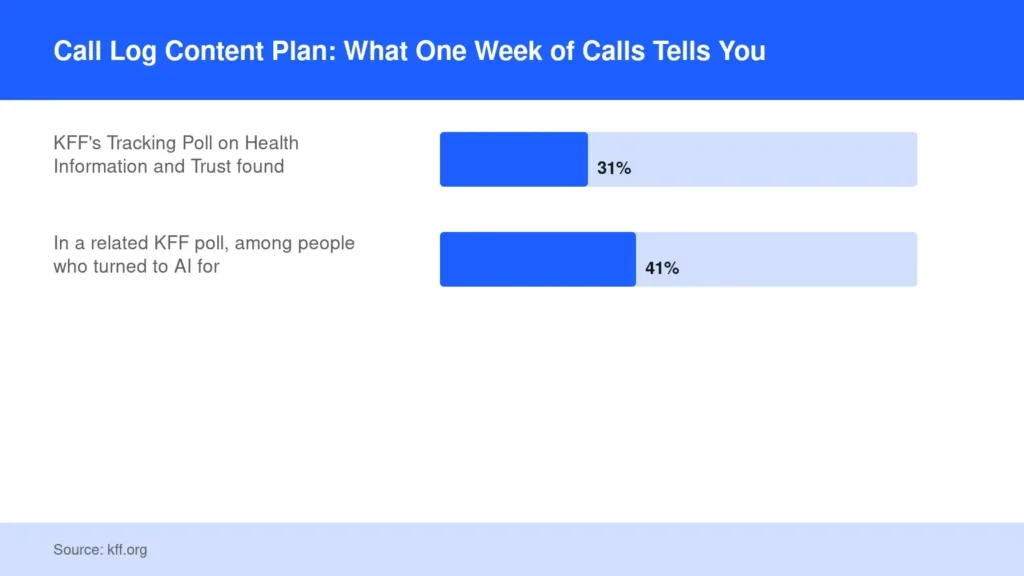
The audience for that guess is no longer small. KFF’s Tracking Poll on Health Information and Trust found three in ten adults (31%) using social media at least monthly for health information and advice, and a similar share (29%) using AI tools or chatbots monthly. In a related KFF poll, among people who turned to AI for health information, 41% said wanting to look up information before seeing a provider was a major reason. That is your first-visit question, asked of a machine.
Google’s own documentation for site owners describes AI Overviews and AI Mode using a “query fan-out” technique, issuing multiple related searches across subtopics to build a response, and states plainly that there are no special optimizations required to appear. Which is the good news and the hard news at once: the only way in is to have published the answer. Silence is not neutral, and it is not free.
How Does This Look at a Practice With More Than One Location?
It multiplies. Every service line and every address creates its own version of the same question, and one generic page cannot answer any of them well.
I am co-founder and Chief of Human Performance at Functionised, which runs FIT Clinic, FIT Lab and FIT Stretch as one clinical wellness ecosystem in Colts Neck, New Jersey, with a second clinic location at Seabrook in Tinton Falls. Three names under one roof are a gift to a patient who needs all three and a puzzle to a stranger on the phone. Is the stretch service in the same building as the clinic? Does lab work happen at the Tinton Falls address? Book one visit or two? None of it is hard. It is simply unwritten in public.
So we ran the tally on ourselves. The week the sheet went up on our monitor, the repeats were not about our methods at all. They were location questions wearing service-question clothes. Not one caller asked what a metabolic reset is; they asked which building to walk into and whether the labs were drawn there. Our answer was a plain page that names each brand, says what happens there and which address it sits at. The desk now sends callers to it instead of drawing a map by phone. That is first-hand, not theory.
The two desks do not hear the same week, either. Seabrook is a retirement community, so those callers open with access, timing and who they will see, while the Colts Neck callers open with what the program involves. One tally sheet per location, or the ranking blurs.
Local detail matters more than owners expect. Monmouth County is not one market: the Census Bureau puts its population above 640,000 people, spread across dozens of separate municipalities with their own names, roads and drive times. A caller from Colts Neck and a caller from the far end of the county ask the same question with different stakes. One wants to know where to park. The other wants to know whether the drive buys lab and stretch on the same visit. A dental group with two offices is the same example, as is a law firm with a second desk an hour away. Multiply the core questions by every location and every service line and the queue never runs dry, which is freeing: the only thing that matters is the next one.
Do You Need a Content Calendar or a Writer on Staff?
No.
The calendar is where practice content dies. A spreadsheet of titles is a promise made by a version of you who was not booked solid in November. Hiring for it is its own project: a job description, interviews, the usual interview questions about customer service skills and juggling tasks, and at the end a position to manage rather than a page that answers the insurance question. That is why your practice website content should stop waiting on you to write.
A single decision is a different kind of task. Pick the question the desk marked most this week, publish the answer with every figure linked to its source, and let the page answer the phone while the office is closed. That is why a call log content plan makes better source material than any brainstorm in a conference room.
How Do You Decide Which Question to Answer Next?
Rank the questions by how often they are asked and how close they sit to a booking, then publish the top one. Insurance and first-visit questions usually win, because the person asking has already decided they want help.
- Count, do not guess. One week of tally marks at the desk beats a year of opinions in a meeting.
- Answer the money question honestly. Federal rules require providers to give uninsured or self-pay individuals a good faith estimate of expected charges when care is scheduled or on request, so the substance of that conversation already exists. Publish its plain-language version.
- Name the specifics. Credentials, method, equipment, who the practitioner is. Vague pages lose to thin ones that are at least concrete.
- Put the address in the answer. Our own tally said location beat method, and a town name in the first sentence does work no adjective can.
- Keep the voice. If the page does not sound like the person a caller will meet, it will not do the job of a good receptionist.
- Publish, then look. Search Console’s performance report lists the actual queries that brought you impressions and clicks, and the next topic usually comes from there.
If you would rather not rank them yourself, a free report on what to publish next does the deciding part, and the book behind the method covers what search and AI reward now.
Frequently asked questions
Why do patients call instead of reading the website?
Because the answer they wanted was not on it, or was buried in a services page written for insiders. People call when a site makes them work. A call log content plan fixes that in the order it matters: when the specific question has its own page with a plain answer in the first sentence, the phone rings for appointments rather than for information, and the desk gets its time back.
Because the answer they wanted was not on it, or was buried in a services page written for insiders. People call when a site makes them work. A call log content plan fixes that in the order it matters: when the specific question has its own page with a plain answer in the first sentence, the phone rings for appointments rather than for information, and the desk gets its time back.
Should I put these answers in an FAQ or in separate posts?
Both, in that order of effort. A short FAQ entry covers the quick version and helps someone scanning; a dedicated post is what earns the search result, because it can answer follow-up questions the same reader asks next. Note that Google now limits FAQ rich results in search to well-known, authoritative government and health websites, per its own structured data documentation at developers.google.com, so write the FAQ for the reader rather than for a rich snippet. Start with the post for your top question, then let the FAQ point to it.
Both, in that order of effort. A short FAQ entry covers the quick version and helps someone scanning; a dedicated post is what earns the search result, because it can answer follow-up questions the same reader asks next. Note that Google now limits FAQ rich results in search to well-known, authoritative government and health websites, per its own structured data documentation at developers.google.com, so write the FAQ for the reader rather than for a rich snippet. Start with the post for your top question, then let the FAQ point to it.
Does answering questions online reduce calls I actually want?
No, it changes what the calls are about. The caller who reads your first-visit page still calls to book, but arrives already knowing what to bring and who they will see. What disappears is the repetitive information call, which is the one your staff handle all day and nobody enjoys.
No, it changes what the calls are about. The caller who reads your first-visit page still calls to book, but arrives already knowing what to bring and who they will see. What disappears is the repetitive information call, which is the one your staff handle all day and nobody enjoys.
Can an agency use this for client practices?
Yes, that is a common way in. Agencies and freelancers who build practice websites face the same bottleneck from the other side: the client approves a content plan and then never sends copy. A partner arrangement or a white-label report lets the agency deliver the publishing without hiring writers for every account.
Yes, that is a common way in. Agencies and freelancers who build practice websites face the same bottleneck from the other side: the client approves a content plan and then never sends copy. A partner arrangement or a white-label report lets the agency deliver the publishing without hiring writers for every account.
The Bottom Line
A call log content plan costs one week of tally marks and tells you more than any brainstorm will. Every repeated question at the desk is a page you have not published yet, and the fall and winter run of new-patient calls is when that gap costs the most. You already know the questions. Your staff can recite them. The only decision left is which one gets answered in public first, and whether the answer sounds like you or like whatever a chatbot stitched together from a directory listing.
If the writing is the part that never happens, hand it off with Blog and Social Posts, Done for You or look at the plans; agencies can start at the partner program. Try it on the question your desk marked most this week, and if you want a hand, help is here.
Start free for 14 days
Sources
- Functionised — Metabolic Reset Program, Colts Neck NJ (FIT Clinic, FIT Lab, FIT Stretch)
- Functionised — home
- KFF Tracking Poll on Health Information and Trust: Use of Social Media and AI For Health Information and Advice
- KFF Tracking Poll on Health Information and Trust: Use of AI For Health Information and Advice
- Creating helpful, reliable, people-first content — Google Search Central
- AI features and your website — Google Search Central
- Requirements Related to Surprise Billing; Part II Interim Final Rule — CMS fact sheet
- QuickFacts: Monmouth County, New Jersey — U.S. Census Bureau
- Performance report (Search) — Google Search Console Help
- FAQ (FAQPage) structured data — Google Search Central