Ask Maps Google Profile: Who Writes Your Answers Now
Key takeaways
- An ask maps google profile answer is now assembled by Google, not typed by you.
- Google has discontinued owner-posted Q&A on the Business Profile and replaced it with Ask Maps, an AI feature that assembles its own reply from your profile fields, your reviews and your website.
An ask maps google profile answer is now assembled by Google, not typed by you. Google has discontinued owner-posted Q&A on the Business Profile and replaced it with Ask Maps, an AI feature that assembles its own reply from your profile fields, your reviews and your website. That means nobody at your practice can type the answer to do you take my insurance or is there parking onto the profile any more, so an ask maps google profile answer is built from source material you may never have written. The work now is to list the questions your front desk fields, decide which page of your own site carries each one, and keep publishing on a cadence instead of a burst.
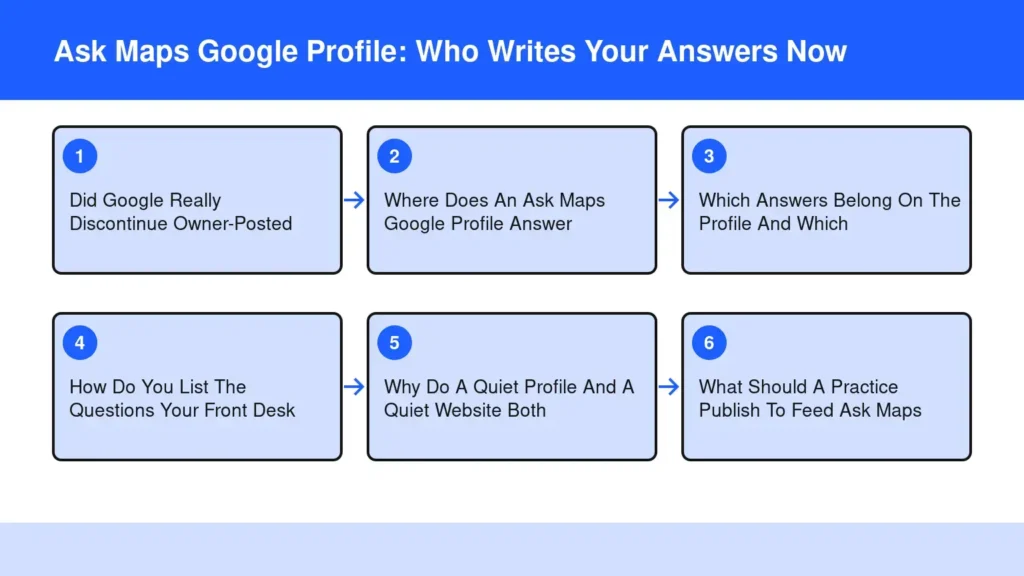
Did Google Really Discontinue Owner-Posted Q&A On Business Profiles?
Yes. Owner-posted Q&A is gone, and an ask maps google profile answer stands in its place. The paper trail is Google’s own. Google’s change log states that the My Business Q&A API was discontinued on November 3, 2025, and the deprecation schedule instructs developers to stop using the Q&A methods and the question and answer notification types.
The notice that went to developers in September 2025 said only that Google was “in the process of updating the Q&A functionality and user experience”. Owners and marketers then watched the public side go: local SEOs reported the Ask A Question button vanishing from live listings and Add Question disappearing from the dashboard.
So the feature that let a practice seed its own answers, in its own words, on the single page most patients see first, is not coming back in that form. The questions did not stop. Only your ability to answer them on the profile did.
Where Does An Ask Maps Google Profile Answer Actually Come From?
From your Business Profile fields, your reviews, your website, and then third-party sources, in roughly that order. Ask Maps draws its short answer from the profile’s descriptions, services, attributes, hours, photos and posts, from customer reviews, and from the business website, turning to third parties if the answer is not there and saying there is not enough information if it still cannot tell.
The scale explains the tone of the thing. Google says that to build these replies, Maps analyzes information from over 300 million places, including reviews from a community of more than 500 million contributors, with the conversational experience rolling out in the U.S. and India on Android and iOS.
Read that list again as an owner. Most of those sources are things other people write; the website is the one you control outright, which is why the question of what a practice publishes for AI answer engines stopped being a marketing nicety and became the front desk’s workload.
Which Answers Belong On The Profile And Which Belong On Your Website?
Short facts that fit a field belong on the profile; anything that needs a sentence, a condition or an exception belongs on a page you own. The profile is a form now, not a notepad.
The description is the one free-text space left, and it is narrow: the field caps at 750 characters and is usually truncated after about 250, so the first lines carry the weight. Fill every structured field around it, then feed the rest. A checklist for the new Ask A Question behaviour puts website content alongside menus, attributes and categories, recommending that customer questions be answered prominently on the site itself.
In practice that splits cleanly. Hours, parking attributes, categories, services and payment options sit in profile fields. Insurance and network questions, where to park and which door to use, what to bring, whether a referral is needed: those need prose, on the page that already ranks for the thing they are about. We walked through that sorting in the front desk questions your website pages should answer first.
How Do You List The Questions Your Front Desk Fields Each Week?
Write them down as they are asked, for one working week, then assign each one to a single page. No software, no survey, no meeting.
- Keep one tally sheet at the desk. Every question that arrives by phone, email or at the counter gets a tick, not a transcript.
- Group the ticks on Friday. Insurance, parking and access, timing, preparation, eligibility, cost, aftercare. Most practices find the same handful dominate.
- Name one owner page per group. One question, one page, in the words the caller used, not the clinical term.
- Check whether that page answers it in the first paragraph. If the answer is buried below the fold, Ask Maps and the answer engines have to guess.
- Mirror the most frequent of them into the profile description and the service fields. Same facts, shorter form.
- Put the rest in a publishing queue, in order of how often they were asked. That queue is your editorial calendar for the quarter.
One week of calls is enough data to plan a quarter, because the questions repeat. We laid out the counting method in what one week of calls tells you, and the sheet is usually more honest than any keyword tool, because it records what a person asked a human being before they decided to book.
Why Do A Quiet Profile And A Quiet Website Both Lose Ground?
Because completeness and activity are what the systems read, and neither one is a one-off task. Google states plainly that local results are mainly based on relevance, distance and prominence, and that relevance improves when you provide complete and detailed business information.
On top of that documented baseline sits a reported pattern rather than a published rule: local SEO guides are now calling out meaningful visibility drops when a profile goes more than 30 days without new photos or updates, while noting that Google publishes no clean thirty-day rule. Treat it as a floor for your own habits, not as gospel.
The consequence is a cadence, not a campaign. A pile of pages published in one weekend and then months of silence reads, to a freshness-weighted system, like a practice that closed. That is the argument for letting the website content stop waiting on the owner to write it, because the owner is the bottleneck every single time.
What Should A Practice Publish To Feed Ask Maps And Its Own Pages?
Publish the answers themselves, one question per page, on a schedule you can keep when the schedule is full. That is the whole method, and it is why I built this.
I spent years as a strength and conditioning coach for the Toronto Blue Jays, the Tampa Bay Buccaneers and the University of South Florida, and I am co-founder and Chief of Human Performance at Functionised, which runs FIT Clinic, FIT Lab and FIT Stretch in Colts Neck, Tinton Falls and Seabrook. I know what the desk sounds like late in the afternoon, and I know that the person who can answer the insurance question properly is the person with no hour to write it down.
It has run on my own four sites since September 2026, which is the only test I trust: the thing publishes in my voice whether or not I have time to think about it. Plans are listed on the pricing page. If you want the stakes spelled out first, read why practices end up losing patients to competitor content they never published.
Frequently asked questions
Can I still see or export my old Google Business Profile questions and answers?
No. Google’s change log confirms the My Business Q&A API was discontinued on November 3, 2025, so questions and answers can no longer be read or posted through it, and the question and answer notification types went with it. Anything you want to keep should be rewritten onto your own website, where you control it and search engines can still read it.
No. Google’s change log confirms the My Business Q&A API was discontinued on November 3, 2025, so questions and answers can no longer be read or posted through it, and the question and answer notification types went with it. Anything you want to keep should be rewritten onto your own website, where you control it and search engines can still read it.
Do near me searches still matter now that Ask Maps answers questions?
Yes. Conversational answers sit on top of local ranking, not instead of it, and Google still says local results are mainly based on relevance, distance and prominence. Someone nearby asking a long, messy question is still filtered by proximity and prominence first, then answered from whatever source material your profile and website supply.
Yes. Conversational answers sit on top of local ranking, not instead of it, and Google still says local results are mainly based on relevance, distance and prominence. Someone nearby asking a long, messy question is still filtered by proximity and prominence first, then answered from whatever source material your profile and website supply.
Is Ask Maps available on desktop Google Search or only in the Maps app?
Google launched the conversational experience in the Maps app, rolling out in the U.S. and India on Android and iOS. Wider surfaces and markets have been signposted rather than dated, so a practice should assume the same source material gets used everywhere eventually and write for the website, which every surface reads.
Google launched the conversational experience in the Maps app, rolling out in the U.S. and India on Android and iOS. Wider surfaces and markets have been signposted rather than dated, so a practice should assume the same source material gets used everywhere eventually and write for the website, which every surface reads.
What happens if Ask Maps cannot find the answer to a question about my practice?
It will tell the person there is not enough information to answer, after it has already tried third-party sources. That is the worst outcome of the three: the patient gets a dead end, or a competitor’s page gets quoted, on a question your front desk answers without thinking about it.
It will tell the person there is not enough information to answer, after it has already tried third-party sources. That is the worst outcome of the three: the patient gets a dead end, or a competitor’s page gets quoted, on a question your front desk answers without thinking about it.
What is still unknown about how Ask Maps chooses its sources?
Google has not published how an ask maps google profile answer weights a profile field against a review against a page on your site, or how quickly a new page gets picked up. What is documented is the input list, so the practical response is to make every input say the same true thing, and to check the answer Ask Maps gives for your own name each month.
Google has not published how an ask maps google profile answer weights a profile field against a review against a page on your site, or how quickly a new page gets picked up. What is documented is the input list, so the practical response is to make every input say the same true thing, and to check the answer Ask Maps gives for your own name each month.
The Bottom Line
Nobody is going to write those answers for your practice by accident. The sequence is small enough to start this week: tally the questions for a week, give each one a page, front-load the answer in the first paragraph, mirror the most frequent into the profile fields, and then keep publishing so the profile and the site never go quiet at the same time.
If the honest problem is that you know all of this and still have no hour in the day, that is the problem we built for. Blog & Social Posts, Done for You decides the next topic, writes it in your voice with its figures linked to their sources, publishes it and shares it. Start with the free report on what you should publish next or the free book, then see how the service works and judge whether it sounds like you.
Start free for 14 days
Sources
- Q&A API change log — Google Business Profile APIs
- Deprecation schedule — Google Business Profile APIs
- How we're reimagining Maps with Gemini: Ask Maps and Immersive Navigation
- Ask anything about any place on Maps with Gemini
- Tips to improve your local ranking on Google — Google Business Profile Help
- A Guide to Google Business Profile Q&A — BrightLocal
- Google Business Profile Description — BrightLocal
- With Google Q&A Gone, You Need a Maps Ask A Question Strategy — Whitespark
- Google Business API Q&A Feature Going Away November 3 — Search Engine Roundtable
- Top 8 Biggest Changes to Google Business Profile in 2026 So Far — Explore Digital