AI Citation Content Gaps: Stop Guessing What to Publish Next
Key takeaways
- AI citation content gaps are the patient questions where ChatGPT, Perplexity or Google's AI answers cite another practice or a national site and never cite yours.
- You find them by listing the questions patients really ask, running each one as a prompt, and marking every answer where your practice is missing.
AI citation content gaps are the patient questions where ChatGPT, Perplexity or Google's AI answers cite another practice or a national site and never cite yours. You find them by listing the questions patients really ask, running each one as a prompt, and marking every answer where your practice is missing. That list of gaps is your publishing plan: each gap is a page you write in your own words, in order of how often patients ask.
What Are AI Citation Content Gaps?
AI citation content gaps are the questions where an AI answer cites a competitor and leaves you out. A citation gap analysis maps where AI answers mention your brand, where they mention rivals, and which sources they lean on. Similarweb’s step-by-step citation gap guide frames it as a method to compare a brand’s citation footprint with competitors and find where others are outperforming it.
For a practice, the brand is your name and the competitors are the clinic down the road, the hospital system, and the national health sites. The questions are the ones your front desk hears every day. When a patient types one into ChatGPT or Google and the answer names someone else, that is a gap.
Each gap is concrete. A patient asked something, someone else answered it in writing, and the AI handed that answer to your patient. You never saw the search, and you never got the call.
Why Does AI Citation Gap Analysis Matter for a Practice?
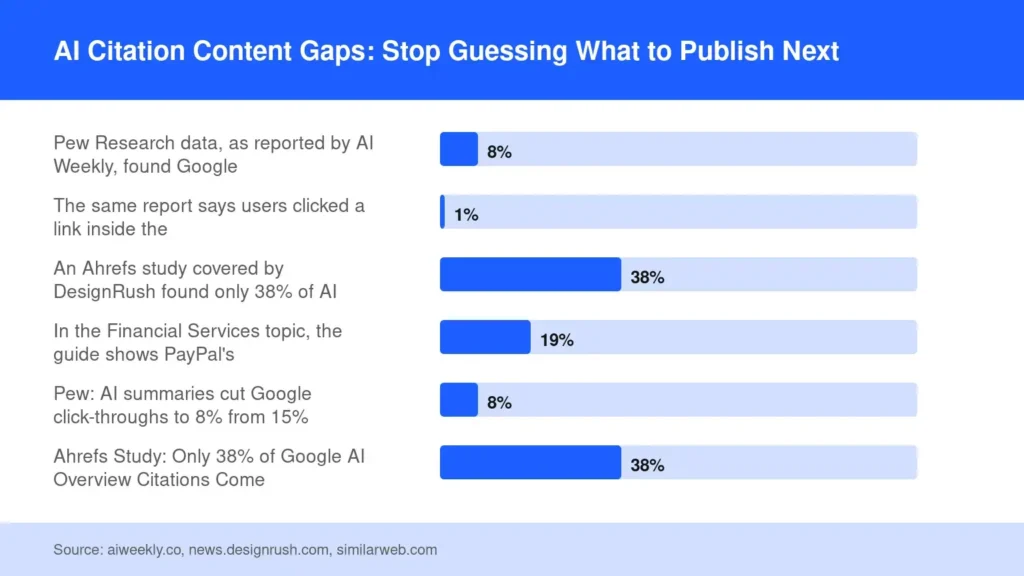
It matters because patients now get answers without clicking, so being named inside the answer is the visibility that counts. Pew Research data, as reported by AI Weekly, found Google users clicked a traditional result in 8% of visits when an AI summary appeared, against 15% without one. The same report says users clicked a link inside the summary in just 1% of visits.
That is loss aversion in plain numbers. If the summary is where the decision happens, the practice it names gets the trust, and everyone else gets silence. Rappler’s coverage of the Pew study adds that AI summaries led to fewer link clicks and more session exits.
Ranking alone does not protect you either. An Ahrefs study covered by DesignRush found only 38% of AI Overview citations come from top 10 pages. A page-one practice can still be missing from the answer. I wrote more on that cost in why you are losing patients to competitor content you never published.
How Do You Run an AI Citation Gap Check for One Practice?
Run it as a checklist: list the questions, ask the AI tools, record who gets cited, and mark every question where you are missing. You need a spreadsheet, a free hour, and your front desk’s memory.
- List the real questions. Pull them from calls, intake forms and review text, in the patient’s own words. My call log content plan shows how a week of calls fills this list.
- Add the local version. Patients often add your town to the question, so test both the plain prompt and the local prompt.
- Ask the same prompts across tools. Use ChatGPT, Perplexity and Google’s AI Mode. Each tool picks its sources differently.
- Record every source cited. Note the domain, whether it is local or national, and whether it is a rival practice, a directory, Reddit or a health publisher.
- Mark the gap. If your site is not cited and your practice is not mentioned, that row is a gap.
- Repeat monthly. Answers shift, so the check is a habit, not a one-off project.
The method is the counting, not the question list. One answer tells you little. A column of answers where the same competitor keeps getting cited tells you exactly who owns the topic.
How Do You Read the Metrics in a Citation Gap Table?
Read three things: your share of answers, who gets cited most, and which topics you are absent from. Vendor dashboards report these as visibility percentages, but a hand-built spreadsheet shows the same pattern.
Similarweb’s guide uses PayPal as its worked example. In the Financial Services topic, the guide shows PayPal’s visibility at 19%, with Betterment, Wealthfront and Revolut each around 14%. The lesson for PayPal is the lesson for you: a lead in one topic can hide a gap in the next, so check visibility topic by topic, not as one total.
What the columns tell a practice owner
Count how many prompts cite you against how many cite each competitor. Then group the prompts by topic, such as first visit, insurance, a specific condition, or recovery. The topic where a rival appears again and again while you never appear is the first thing to publish. The question most visitors ask about PayPal, how to help it close its gaps, has the same answer for a practice: publish the specific page the answers keep citing someone else for.
Can ChatGPT Do a Gap Analysis for You?
ChatGPT can help you draft the question list and sort the results, but it cannot reliably report where it cites you. You still need to run the prompts yourself and record what each answer shows.
OpenAI’s own guide to research with ChatGPT says to always review linked sources before making decisions, since search results reflect what is available on the web. That is the right stance for a gap check. The tool is a research assistant, not an auditor of its own citations.
AI can also help identify research gaps in a broader sense, such as subtopics nobody covers well. Treat those suggestions as leads to confirm against real patient questions. A topic with no patient behind it is not a gap worth filling.
How Do You Turn the Gap List Into a Publishing Plan?
Treat every marked gap as the next page to publish, ordered by how often patients ask it. The list replaces guessing. You stop asking what to write and start working down rows.
Google’s documentation on AI features and your website explains how AI Overviews and AI Mode work from a site owner’s view. Semrush’s report on Google’s guide quotes Google: the best practices for SEO “continue to be relevant” because the AI features are rooted in core ranking. So the page that fills a gap is a plain, sourced, first-hand answer, not a trick. My piece on first-hand experience content covers what that looks like.
I have run this on my own four sites since September 2026, and the discipline is the same one I used as a strength and conditioning coach for the Toronto Blue Jays, the Tampa Bay Buccaneers and the University of South Florida. You test, you find the weak link, you train that link first. For a practice, the weak link is the question a rival answers and you do not. If writing is the bottleneck, publishing consistency without writing is the next read.
Frequently asked questions
How accurate are AI citations?
AI citations point to real pages, but the cited page does not always fully support the claim beside it. LLM Pulse’s explainer on how Perplexity works notes that citations let readers inspect sources without guaranteeing every claim is supported. For a gap check, record which domain is cited, then open it to see what it actually says.
AI citations point to real pages, but the cited page does not always fully support the claim beside it. LLM Pulse’s explainer on how Perplexity works notes that citations let readers inspect sources without guaranteeing every claim is supported. For a gap check, record which domain is cited, then open it to see what it actually says.
How do you properly cite AI-generated content on a practice website?
Cite the original source the AI drew from, not the AI itself. Open the page the answer linked, confirm the figure there, and link that page in the same sentence on your site. Patients and search engines trust a named, checkable source far more than a line saying a chatbot said so.
Cite the original source the AI drew from, not the AI itself. Open the page the answer linked, confirm the figure there, and link that page in the same sentence on your site. Patients and search engines trust a named, checkable source far more than a line saying a chatbot said so.
Do Reddit threads and directories count as competitors in AI answers?
Yes, any source an AI answer cites instead of you takes the place you wanted. Directories, review sites and Reddit threads often fill local questions when practices have not published a clear answer. Log them in your gap table like any rival, because the fix is the same: publish the better first-hand answer.
Yes, any source an AI answer cites instead of you takes the place you wanted. Directories, review sites and Reddit threads often fill local questions when practices have not published a clear answer. Log them in your gap table like any rival, because the fix is the same: publish the better first-hand answer.
How often should a practice repeat a citation gap check?
Monthly is a sensible rhythm for most independent practices. AI answers change as new pages appear and models update, so a gap you closed can reopen. Rerun the same prompts, compare against the previous sheet, and pair it with your Search Console AI impressions to see which new pages are earning visibility.
Monthly is a sensible rhythm for most independent practices. AI answers change as new pages appear and models update, so a gap you closed can reopen. Rerun the same prompts, compare against the previous sheet, and pair it with your Search Console AI impressions to see which new pages are earning visibility.
The Bottom Line
Your AI citation content gaps are already sitting in your call log. List the questions, run them across ChatGPT, Perplexity and Google, mark every answer that names someone else, and publish down that list in your own voice. Each row you fill is a patient question you stop handing to a rival. For the bigger picture, read what practices must publish to get found by AI answer engines.
If the hours are the problem, let the gap list drive the writing for you. Blog & Social Posts, Done for You decides what to publish, writes it in your voice with every figure linked to its source, publishes it and shares it. Try it.
Start free for 14 days
Sources
- AI Citation Gap Analysis: Step-By-Step Guide & Template (Similarweb)
- AI Features and Your Website (Google Search Central)
- Google publishes guide to optimizing for generative AI search (Semrush)
- Pew: AI summaries cut Google click-throughs to 8% from 15% (AI Weekly)
- Google users less likely to click links if presented with AI summaries (Rappler)
- Ahrefs Study: Only 38% of Google AI Overview Citations Come From Top 10 Pages (DesignRush)
- ChatGPT for research (OpenAI Academy)
- Research with ChatGPT (OpenAI Academy)