AI Mode Info Monitoring: What a Patient’s Agent Rereads
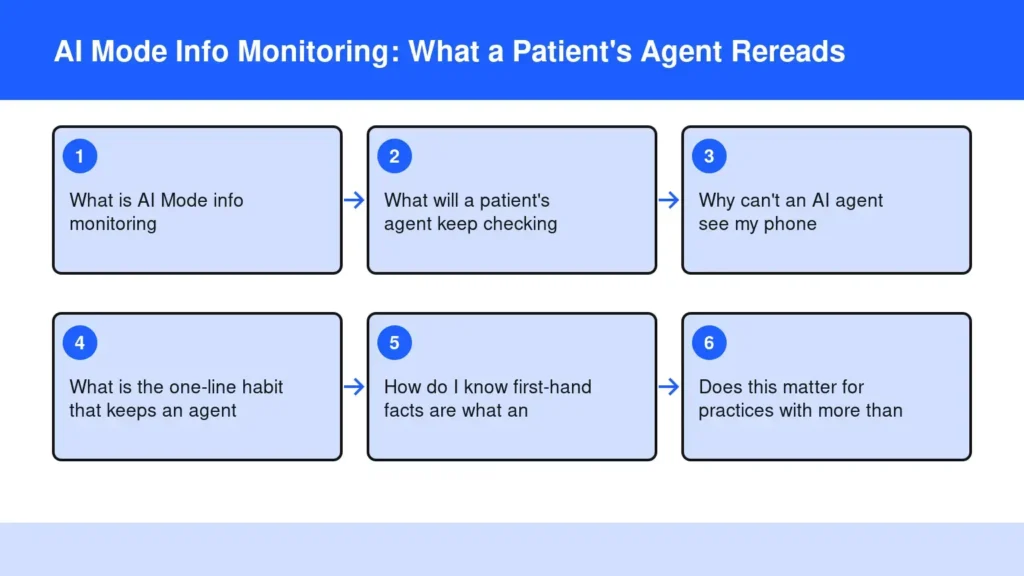
Key takeaways
- AI mode info monitoring lets a patient ask Google's AI to keep checking a practice for them, instead of searching once and forgetting.
- The agent can only read what is written somewhere it can reach, so a change that lives on a phone greeting or a door sign doesn't exist for it.
AI mode info monitoring lets a patient ask Google's AI to keep checking a practice for them, instead of searching once and forgetting. The agent can only read what is written somewhere it can reach, so a change that lives on a phone greeting or a door sign doesn't exist for it. The fix is a small habit: every operational change gets one written, dated line on your site in the same week it happens.
What is AI Mode info monitoring?
AI Mode info monitoring is a Google Search feature that lets a person ask the AI to keep tracking a topic and report back when something changes. For a practice, that means a patient can hand off the job of watching your details to an agent that keeps checking.
Google opened the feature to all Search users through the Google app, after first limiting it to paid AI subscribers. That changes who uses it. It’s no longer a tool for early adopters. Any patient with the Google app can set it up. Search will also suggest monitoring tasks during searches, so some patients will be offered it without going looking.
The same report notes that the system scans sites, forums, social posts and shopping data. Your website is one of the places it reads, and it’s the only one you fully control. Google’s own guide says AI Mode may use a “query fan-out” technique, which runs several related searches across subtopics and sources to build one answer. A dated line on your site gives those searches one more place to find the change.
What will a patient's agent keep checking about my practice?
It will most likely keep rereading the details a patient acts on: your hours, new services, which providers are available, and closures. Those are the things people ask about before they pick up the phone.
- Hours. Holiday hours, a late evening added, a Saturday dropped.
- New services. A treatment you just started offering, or one you stopped.
- Provider availability. A new clinician joining, someone on leave, a provider taking new patients again.
- Closures. Weather days, a move, a location that’s shutting.
Practices are already in the path. Google has added help booking beauty and wellness appointments to AI Mode for Search Labs users in the U.S.
Someone who sets up monitoring is a patient who has already decided they care. They’re waiting for one thing to change. If you write it down, the agent can tell them.
Why can't an AI agent see my phone greeting or door sign?
An agent reads text published online, and a recorded greeting or a taped-up sign never reaches the web. To the agent, a change you only announced that way hasn’t happened.
That’s the gap I worry about most for independent practices. The front desk updates the voicemail, someone prints a notice for the door, and everyone in the building knows. The patient’s agent keeps reading the old hours on your site and reports nothing new, or reports something wrong.
Your Google Business Profile matters here too, but it holds a fixed set of fields. Google also reviews profile edits before they go live, so a change there doesn’t always show up right away. A dated line on your own site can say why the change happened and what the patient should do about it. Being found as the official site only helps if that site is current.
What is the one-line habit that keeps an agent accurate?
That’s the whole habit.
How to write the line
- Lead with the date, then the change, in one plain sentence.
- Name the location and the provider if more than one applies.
- Add what the patient should do: book, call, or wait.
- Put it on a page that stays live, like a practice updates page, not a pop-up that disappears.
Who owns it
Give the job to whoever changes the phone greeting. If the greeting changes, the line goes up the same week. Your front desk call log works as a backup: if patients keep asking about a change, it isn’t written down clearly enough yet.
How do I know first-hand facts are what an agent can use?
Only facts that come from you, and that nobody else could write, give an agent a reason to report back about your practice in particular. I’ve seen this in our own publishing.
We use a publishing system I built first for my own multi-location wellness practice and my film and book sites. Every post goes through a review pass, and a draft that can’t say two things only that business can say is set aside rather than published.
On one of those sites, in one week, the review set aside 9 of 14 drafts. The site’s facts held too little that only that business could say. That’s the lesson for monitoring too. A dated line about your own hours or your own new provider is exactly the kind of first-hand fact nobody else can publish. Google’s people-first content guidance asks whether a page provides original information, reporting, research, or analysis, and a dated update from your own front desk does.
Does this matter for practices with more than one location?
Yes, more so. Each location changes on its own schedule, and a patient watching one location doesn’t care about the others.
Functionised runs FIT Clinic, FIT Lab and FIT Stretch in Colts Neck, Tinton Falls and Seabrook. Hours and staffing don’t move in lockstep across three towns. A single generic notice that covers everything doesn’t help a patient’s agent figure out which change applies to them.
So write one line per location per change, and name the town in it. Do the same in your review replies.
Frequently asked questions
Should a practice post updates on social media instead of its website?
Post on both if you like, but treat the website as the record. Monitoring systems read social posts as well as sites, but a social post scrolls away while a dated line on your site stays put and sits next to your hours and services. If the two ever disagree, the site is the version you control completely.
Post on both if you like, but treat the website as the record. Monitoring systems read social posts as well as sites, but a social post scrolls away while a dated line on your site stays put and sits next to your hours and services. If the two ever disagree, the site is the version you control completely.
What if a change is temporary, like a single closed afternoon?
Write it anyway, with the date and the words that make it temporary. A patient watching for availability gains as much from a short closure note as from a permanent change. After the date passes, leave the line where it is. A dated history tells readers and agents that your site stays current.
Write it anyway, with the date and the words that make it temporary. A patient watching for availability gains as much from a short closure note as from a permanent change. After the date passes, leave the line where it is. A dated history tells readers and agents that your site stays current.
Can an outdated website hurt a practice with AI agents?
Yes. An agent that keeps reading stale hours can pass old information to a patient who trusted it to watch for changes. The patient may show up to a locked door or book elsewhere. That costs you the visit and the patient’s confidence in what your practice publishes.
Yes. An agent that keeps reading stale hours can pass old information to a patient who trusted it to watch for changes. The patient may show up to a locked door or book elsewhere. That costs you the visit and the patient’s confidence in what your practice publishes.
Who should write the dated update lines at a small practice?
Whoever already updates the phone greeting or prints the door sign. That person knows about the change first, so tying the written line to that task keeps the lag at zero. An office manager can write one plain sentence in a few minutes. No marketing skill is needed, only the date, the change and what patients should do.
Whoever already updates the phone greeting or prints the door sign. That person knows about the change first, so tying the written line to that task keeps the lag at zero. An office manager can write one plain sentence in a few minutes. No marketing skill is needed, only the date, the change and what patients should do.
The Bottom Line
A patient’s agent keeps checking only what you’ve written down. Hours, new services, provider availability and closures are what it rereads. One written, dated line on your site in the same week as each change closes that gap.
Start free for 14 days
Sources
- Google AI Mode Info Monitoring Now Open to All Users (TechWyse)
- Google Rolls Out AI Mode Info Monitoring To All Users Globally (Search Engine Journal)
- AI features and your website (Google Search Central)
- Google's AI Mode gets new agentic capabilities to help book event tickets and beauty appointments (TechCrunch)
- Edit your Business Profile (Google Business Profile Help)
- Creating helpful, reliable, people-first content (Google Search Central)