Google Ranking Update History: Know What Caused the Drop
Key takeaways
- Before you blame your website for fewer new-patient enquiries, check Google ranking update history on the Search Status Dashboard.
- Match its dated start and end times to your Search Console graph.
Before you blame your website for fewer new-patient enquiries, check Google ranking update history on the Search Status Dashboard. Match its dated start and end times to your Search Console graph. A drop that begins the day a confirmed update began is one problem. A drop that started weeks earlier usually traces to a season, a removed page or a competitor that published. Once you know which, you can wait, fix or write.
Where Is Google Ranking Update History Kept, and Why Check It First?
It is a public page where Google logs each confirmed update with a dated start and end. Check it first, because it tells you in minutes whether the ground moved under every site or only under yours.
The Google Search Status Dashboard reports on the services that are part of Google Search. Its front page carries a ranking row beside crawling, indexing and serving. Google added that ranking section in March 2023, with history promised back to 2020. Its own help page says past entries stay on the Summary and History pages for five years.
Open the ranking history page and you get a plain list of each update’s name, start date and duration. As of 8 October 2026, PPC Land counted 42 entries, the oldest being the November 2021 spam update. The same explainer notes that every time on the dashboard is US Pacific. East Coast practices should shift the clock before they compare.
Almost no practice owner has ever opened it. That is the opportunity. When new-patient enquiries sag, the dashboard turns a vague fear into a dated question. Did the drop begin when a confirmed update began, or before it?
What Are the Major Google Core Updates in 2026?
Google confirmed two broad core updates in 2026 through early October, in March and May, plus a Discover core update in February. The September spam update was the fourth spam update of 2026, and the list below runs the main entries in order.
- February Discover core update: Google released it on February 5, 2026 as a broad change to the systems that surface articles in Discover. It finished on February 27 after 22 days.
- March spam update: it began March 24 and finished in under 20 hours, according to the dashboard.
- March core update: the first broad core update of the year ran from March 27 to April 8. Google called it a regular update.
- May core update: the second core update ran from May 21 to June 2, 2026. Search Engine Roundtable felt it was larger than the March core update.
- August spam update: Google launched the spam update August 18, 2026, aimed at sites that violate its spam policies. It took only two days to roll out.
- September spam update: Google started the update September 24, 2026, saying the rollout could take up to two weeks.
Was There a Recent Google Algorithm Update?
Yes. The September 2026 spam update is the latest confirmed entry. The dashboard’s front page, last updated on 10 October 2026, showed no open incidents. Barry Schwartz of Search Engine Roundtable wrote that the industry is “all expecting a new core update soon”. So the owners most likely to panic at a dip are about to get one to panic about. The useful question is whether it will be yours, and whether you can prove the cause.
How Do You Line Up the Dashboard Against Your Search Console Graph?
Put two sets of dates side by side. One is the update window from the dashboard; the other is the start of your own dip in the Search Console Performance report. If your dip begins inside the update window, the update is your first suspect. If it began weeks earlier, look inside the building.
Here is the checklist I would hand any office manager.
- Widen the view. Google’s guide to traffic drops suggests setting the Performance date filter to the last 16 months, so you can see the same season a year earlier.
- Mark the dip. Google’s traffic drop help page says to find the approximate start and end dates, then restrict the date filter to that stretch.
- Open the dashboard. Note every entry on the ranking list whose window overlaps yours, and convert Pacific time to your own.
- Split the data. The same support article suggests looking for a pattern by query, country and device. Add the Pages tab to see whether one URL or the whole site fell.
- Compare clicks with impressions. If impressions held but clicks fell, Google’s debugging guide points at your title and snippet, or a rival’s more appealing rich result.
- Look at the wider web. Run your top lost queries through Google Trends, as the same guide recommends, to see whether interest fell everywhere.
Write down what you found, with the dates. A dated note turns a nervous phone call into a calm one. If your graph also shows AI impressions, read them apart from classic clicks; we covered that in Search Console AI impressions.
What Does Each Drop Pattern in Search Console Mean?
Each cause leaves a different fingerprint, and the fingerprint is mostly timing and spread. These are the four patterns that matter most on a practice website.
A drop that starts with a confirmed update
The dip begins on or just after the start date and settles as the rollout ends. It usually spreads across many pages at once. Search Engine Journal notes that core updates aren’t targeted at specific types of content or policy violations. Pages move as Google reassesses quality across the web. A spam update is narrower and targets sites violating Google’s spam policies. If yours lines up with one, our guide to the AI content spam update covers what to check first.
A drop that repeats every season
Seasonality looks like a dip that matches the same weeks a year earlier. Google’s guide lists seasonality and changing interests as external influences, not faults on your site. Many patient searches follow the calendar, and a quiet stretch can simply be the calendar talking.
A cliff on one page that was removed or blocked
A sudden fall on a single URL, while the rest of the site holds, points inside the building. Google’s support article names pages someone removed, or blocked with robots.txt or a noindex rule. A redesign that quietly dropped an old services page is the classic case. An older Search Central post adds that a misplaced noindex tag tends to cause a slower slide, because it waits on Google crawling the page.
A slow slide while a competitor publishes
This pattern has no date on any dashboard. Impressions on a group of questions erode gradually, often while a practice down the road answers those questions in writing. Search the queries you lost and see who holds them now. We wrote about that loss in competitor content you never published.
How Often Does Google Update Its Search Algorithm?
Google changes its search systems constantly, but the dashboard lists only the ranking updates relevant to website owners. That makes the confirmed entries rare enough to test against, and common enough that one will overlap a dip sooner or later.
The confirmed ones vary widely. On the ranking history page, the March 2024 core update ran 45 days. The December core update of 2024 ran just 6 days and 4 hours. The same page lists the November 2023 reviews update, the February 2023 product reviews update, the September 2023 helpful content update and the December 2022 link spam update. Names change over time; core and spam entries recur throughout.
How Google Algorithm Updates Impact SEO and Organic Search
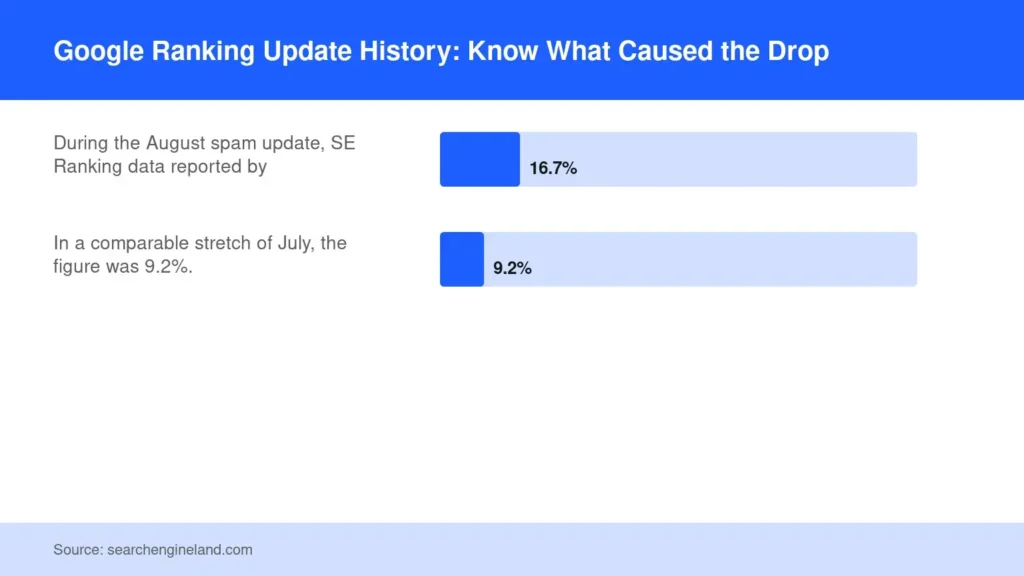
Confirmed updates move rankings harder than ordinary churn. During the August spam update, SE Ranking data reported by Search Engine Land showed 16.71% of top-10 URLs falling beyond position 100. In a comparable stretch of July, the figure was 9.2%. That is real movement. It still doesn’t mean every dip during an update came from the update, which is why the dates matter more than the headlines.
Why Do Agencies Get Fired for Weather and Kept for Drought?
Because owners judge the month they can see. An agency loses a client after a core update dip it didn’t cause, and keeps that client through a long, quiet decline it never explained.
Weather is the update: a dated, web-wide event that hits good sites and bad ones alike. Drought is the slow loss of questions nobody answered on the site. Weather passes. Drought compounds, and it never appears on Google’s dashboard.
I came to this work from strength and conditioning. I was a strength and conditioning coach for the Toronto Blue Jays, the Tampa Bay Buccaneers and the University of South Florida. I also hold the CSCS credential. The reflex that transfers is simple: read the trend across weeks before you rewrite the program. A website report deserves the same patience.
What an agency should send instead of an apology
- The dashboard entry and its dates, linked.
- The Search Console graph with the dip marked.
- A plain verdict: update, season, removed page or competitor.
- The fix, or the reason to wait for the rollout to end.
An agency that sends that note before the client asks becomes the calmest voice in the room. That is authority, earned with dates rather than adjectives. The drought part is harder, because the fix is content the client never has time to write.
Frequently asked questions
Is SEO dead or evolving in 2026?
Evolving. Google keeps shipping confirmed core and spam updates, and its stated aim stays the same: surface relevant, satisfying content. What fades is the trick that worked until the next update. A practice that answers real patient questions clearly, with sources, gives Google Search, Maps and AI answer engines the same useful thing to read.
Evolving. Google keeps shipping confirmed core and spam updates, and its stated aim stays the same: surface relevant, satisfying content. What fades is the trick that worked until the next update. A practice that answers real patient questions clearly, with sources, gives Google Search, Maps and AI answer engines the same useful thing to read.
Does Google announce every ranking update?
No. Google’s core updates documentation, as Search Engine Land reported, says it is constantly making updates, including smaller core updates, and doesn’t announce them all because they’re generally not widely noticeable. It adds that these smaller updates can still help content recover when improvements warrant. So a gradual change with no dashboard entry can still be algorithmic, not a fault on your site.
No. Google’s core updates documentation, as Search Engine Land reported, says it is constantly making updates, including smaller core updates, and doesn’t announce them all because they’re generally not widely noticeable. It adds that these smaller updates can still help content recover when improvements warrant. So a gradual change with no dashboard entry can still be algorithmic, not a fault on your site.
Can a spam update hurt a practice website that doesn't spam?
It can, though not by design. Google aims spam updates at sites that break its spam policies, yet Search Engine Roundtable notes that any update can bring collateral damage. If a clean site dips during one, confirm the dates first, then look for thin, copied or doorway-style pages before changing anything else.
It can, though not by design. Google aims spam updates at sites that break its spam policies, yet Search Engine Roundtable notes that any update can bring collateral damage. If a clean site dips during one, confirm the dates first, then look for thin, copied or doorway-style pages before changing anything else.
Should I change my website while a core update is rolling out?
Usually not. Rankings shift throughout the rollout window, so edits made mid-rollout blur the cause. Wait until the dashboard posts its completion note, then compare equal stretches before the start and after the end. Fix only what that comparison shows, and keep a dated note of every change you make.
Usually not. Rankings shift throughout the rollout window, so edits made mid-rollout blur the cause. Wait until the dashboard posts its completion note, then compare equal stretches before the start and after the end. Fix only what that comparison shows, and keep a dated note of every change you make.
What should an office manager track to spot a search drop early?
Track new-patient enquiries by source, clicks and impressions in the Search Console Performance report, and the ranking row on Google’s status dashboard. Log every site change with its date: redesigns, removed pages, new plugins, hosting moves. That log, kept beside the graph, turns a later diagnosis into a quick lookup instead of a guess.
Track new-patient enquiries by source, clicks and impressions in the Search Console Performance report, and the ranking row on Google’s status dashboard. Log every site change with its date: redesigns, removed pages, new plugins, hosting moves. That log, kept beside the graph, turns a later diagnosis into a quick lookup instead of a guess.
The Bottom Line
Before you blame your website, open Google’s ranking history and lay its dates over your own graph. If they match, wait for the rollout to finish and judge the result. If they don’t, the cause is a season, a missing page or a competitor who wrote what you didn’t.
The habit that survives every update is answering patient questions in writing, on a schedule. Start with the questions your front desk hears most, and keep your publishing consistent. If the hours aren’t there, that is the job of Blog & Social Posts, Done for You It has run on my own four sites since September 2026. Look over the plans, then try it.
Start free for 14 days
Sources
- Google Search Status Dashboard
- Google Search Status Dashboard: History for Ranking
- How to Use the Google Search Status Dashboard (Google Search Central)
- Google adds ranking update history to Search Status Dashboard (Search Engine Land)
- Explaining Search Status Dashboard (PPC Land)
- Google's February 2026 Discover Core Update (Google Search Central Blog)
- Google's March 2026 Spam Update Is Already Complete (Search Engine Journal)
- Google Confirms March 2026 Core Update Is Complete (Search Engine Journal)
- Google May 2026 Core Update Has Completed Rolling Out (Search Engine Roundtable)
- Google August 2026 Spam Update Has Been Unleashed (Search Engine Roundtable)
- Google September 2026 Spam Update Has Been Unleashed (Search Engine Roundtable)
- Google's August 2026 spam update hit rankings harder than normal (Search Engine Land)
- Google confirms it releases smaller, unannounced core updates (Search Engine Land)
- Debugging drops in Google Search traffic (Google Search Central)
- Analyzing Google Search traffic drops (Google Search Central Blog)
- Why did my site traffic drop? (Search Console Help)