Fake Author Profiles Google Flags and the Honest Byline Fix
Key takeaways
- The name on a practice blog post should be a real person who stands behind it, usually the owner, with credentials they actually hold.
- Google's guidance now treats invented writer profiles as deception, so a stock Dr.
The name on a practice blog post should be a real person who stands behind it, usually the owner, with credentials they actually hold. Google's guidance now treats invented writer profiles as deception, so a stock Dr. persona or an AI headshot makes a page look untrustworthy. A tool can do the writing; it just must not invent the writer.
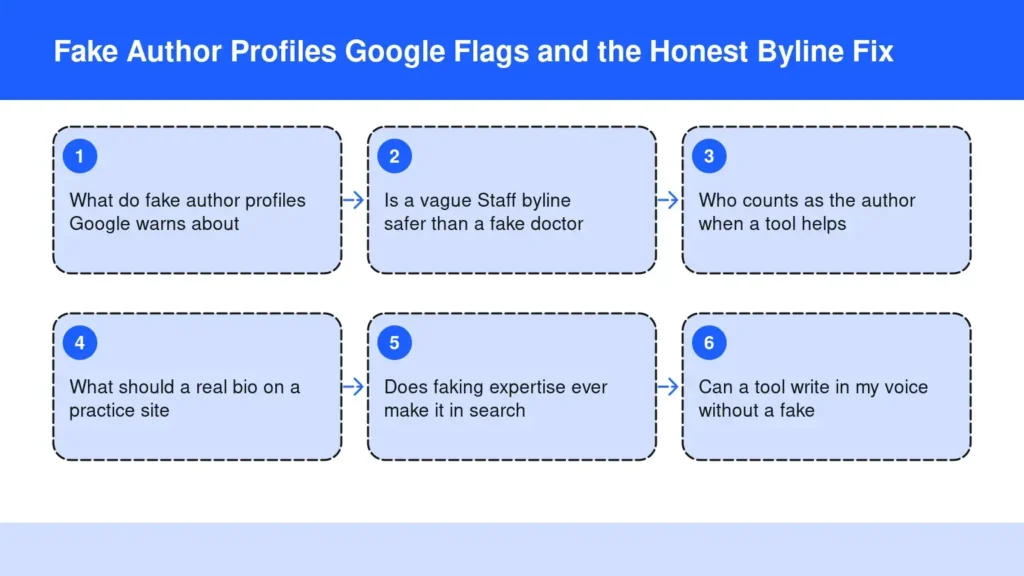
What do fake author profiles Google warns about look like?
Fake author profiles Google warns about are made-up names, AI-generated headshots and false credentials used to make content seem expert-written. Its guidance on helpful, people-first content calls that deception and a sign of a low-quality page.
On practice sites, the usual suspects are easy to spot. A stock image labelled with a doctor nobody on staff has met. A bio that lists degrees no one can verify. A face that machine learning generated, attached to a name an agency made up.
None of this needs bad intent to do damage. Someone picked a placeholder years ago, and it never went away.
Is a vague Staff byline safer than a fake doctor?
A Staff byline is honest, but it wastes the trust your real name could earn. The same guidance strongly encourages accurate bylines where readers expect them, linked to more about the writer.
Health readers expect a name. They want to know who is telling them when to worry about a symptom. A faceless team label answers none of that, even on a good page.
The fix for a busy practice is a short bio page and your own photo. You don’t need to become a writer to be the name on the post.
Who counts as the author when a tool helps write the post?
The true writer is the person whose knowledge, judgement and name the post carries, and who would answer for it. The guidance says using AI gives content no special gains; what counts is whether it is helpful and original.
So the right question is not whether technology touched the draft. It’s whether the post says what the owner would actually say, and whether they would sign it.
That is the line I hold now. My first app, Blog & Social Posts Done for You, runs on my four sites, under my name.
What should a real bio on a practice site include?
A real profile needs a real name, a real face, credentials the person actually holds, and the work they’ve done. Keep it short and checkable.
Here is what I list. I was a strength and conditioning coach for the Toronto Blue Jays, the Tampa Bay Buccaneers and the University of South Florida. I hold the NBCE and CSCS credentials.
- Name and photo: the owner, not a model.
- Credentials: only ones a patient could look up.
- Experience: where you trained and whom you help.
- Links: a LinkedIn page or licence lookup, if you use them.
Does faking expertise ever make it in search?
Faking it may seem to work for a while, but the guidance says any form of deception makes a page untrustworthy to people and to automated systems. That loss keeps compounding over the long run.
It isn’t only search. The FTC’s rule on reviews covers testimonials from someone who does not exist, including AI-generated ones. The same instinct should guide bylines.
An agency that would create fake personas puts the client’s business at risk, not its own company. Ask to see who each byline really is.
Can a tool write in my voice without a fake person on my site?
Yes. A good tool learns how you explain things, writes under your real name, and leaves the credentials to you. It must never invent experts to fill the byline.
Your voice lives in the questions patients ask and the way you answer them. Feed a tool that, and many drafts start to sound like you. I’ve written more on first-hand experience content and on practice website content that stops waiting on you.
Then continue the habit week after week, every year. Publishing consistency matters more than a few perfect posts.
Frequently asked questions
Can I report fake reviews on Google?
Yes. Open your Business Profile, find the review, click the three dots and choose Report review, then pick the rule it breaks. Report only content that breaks policy, not reviews you simply dislike. Reply calmly in public while you wait. Fake reviews and fake bylines come from the same shortcut, and patients deserve better from both.
Yes. Open your Business Profile, find the review, click the three dots and choose Report review, then pick the rule it breaks. Report only content that breaks policy, not reviews you simply dislike. Reply calmly in public while you wait. Fake reviews and fake bylines come from the same shortcut, and patients deserve better from both.
Can I use a pen name on my practice blog?
A pen name is risky on health content, because readers rely on knowing who stands behind advice. The concern is a name made up to suggest expertise that isn’t there. If someone real writes under a pen name, keep their actual credentials honest and never borrow a doctor’s title.
A pen name is risky on health content, because readers rely on knowing who stands behind advice. The concern is a name made up to suggest expertise that isn’t there. If someone real writes under a pen name, keep their actual credentials honest and never borrow a doctor’s title.
Should I list AI in the byline of my posts?
Usually not. A byline tells readers which person stands behind the advice, and software can’t hold a licence or answer a patient. Credit the clinician who shaped the content and would answer for it, and if you’re asked, explain your process openly on an about page.
Usually not. A byline tells readers which person stands behind the advice, and software can’t hold a licence or answer a patient. Credit the clinician who shaped the content and would answer for it, and if you’re asked, explain your process openly on an about page.
How do I make a fake search results page to preview a post?
You don’t need one. Agencies often mock up a result in a design file to show a client the title and description, and that’s fine as a private draft. Publishing a page that imitates a search engine to mislead visitors is the same kind of deception as a fake byline.
You don’t need one. Agencies often mock up a result in a design file to show a client the title and description, and that’s fine as a private draft. Publishing a page that imitates a search engine to mislead visitors is the same kind of deception as a fake byline.
What should an agency do with personas it already created?
Replace each persona with the real person whose expertise the post reflects, and update the bio, photo and credentials to match. Tell the client plainly why the change will help. Keeping old fake profiles live leaves the business carrying the risk for a shortcut it never chose, along with the potential loss of trust.
Replace each persona with the real person whose expertise the post reflects, and update the bio, photo and credentials to match. Tell the client plainly why the change will help. Keeping old fake profiles live leaves the business carrying the risk for a shortcut it never chose, along with the potential loss of trust.
The Bottom Line
Take the stock doctor down, put your own name and photo up, and list only credentials you hold. If keeping up is the hard part, that’s what I built Blog & Social Posts, Done for You to handle, under your name.
Start free for 14 days
Sources
- Creating Helpful, Reliable, People-First Content (Google Search Central)
- Google Search's guidance about AI-generated content
- Federal Trade Commission Announces Final Rule Banning Fake Reviews and Testimonials
- How to Remove Fake Reviews from Google (Whitespark)
- FTC Finalizes Rule Prohibiting Fake Reviews (Davis Wright Tremaine)
- Updating our site reputation abuse policy (Google Search Central)