Helpful Content Accuracy Health: Check One Page Before Lunch
Key takeaways
- Google's helpful content accuracy health bar means a health page must be highly accurate and match expert consensus.
- Raters also judge its effort, originality and skill.
Google's helpful content accuracy health bar means a health page must be highly accurate and match expert consensus. Raters also judge its effort, originality and skill. An office manager can test one page by tracing every claim to a linked source. Then ask whether a template could have written it, and fix any line that fails either test.
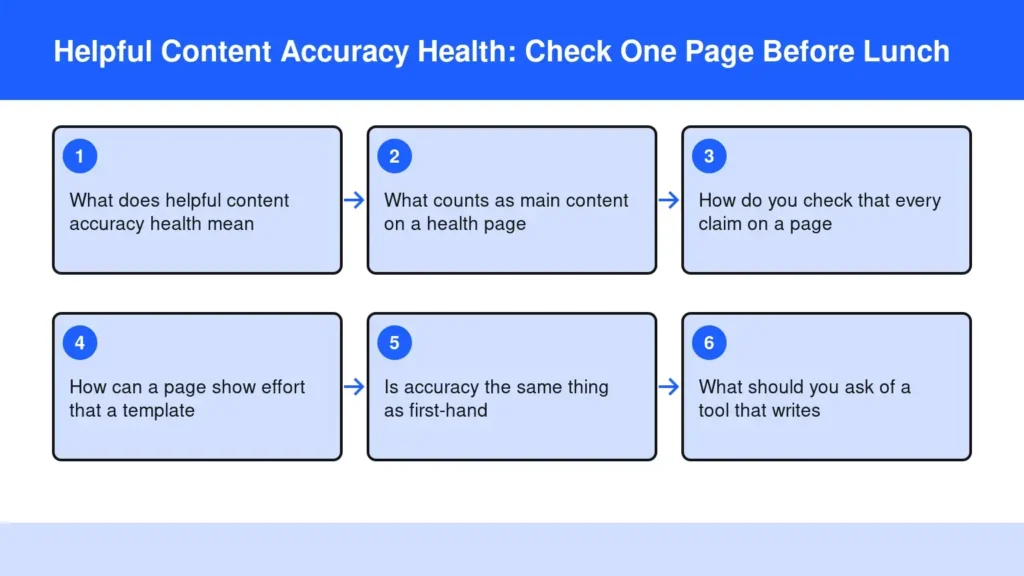
What does helpful content accuracy health mean for a practice page?
It means a health page has to be right, and provably right. For topics that could affect people’s well-being, Google’s rater guidance says content must be highly accurate and consistent with established expert consensus.
Google calls those topics Your Money or Your Life. When raters land on one, the handbook tells them to hold it to especially high standards on every quality question. Health sits squarely in that group. A chiropractic, dental or physical therapy page starts with the higher bar already set.
Accuracy is one of four attributes raters weigh in the main content. The other three are effort, originality, and talent or skill. The checklist below covers the two a front office can test without a clinician in the room: sourcing and effort.
What counts as main content on a health page?
Main content is everything on the page that serves its purpose, not just the paragraphs. Treat the headings, tabs, reviews block and any booking tool as part of what raters judge.
That matters because a weak spot anywhere in that area drags the whole page down. Portent reads the guidelines this way: a highly inexpert YMYL page should be considered Untrustworthy and rated Lowest. A wrong figure hidden in a tab still counts as wrong.
So before you start, open the page and list its parts:
- Every heading and subheading
- Every tab, accordion and expandable answer
- Every review, testimonial or quoted patient comment
- Every tool, form or calculator
Each item on that list gets the same two tests that follow.
How do you check that every claim on a page traces back to a source?
Highlight every sentence that states a fact about the outside world, then find the page that proves it. If you cannot find that page in a few minutes, a patient or a rater cannot either.
The National Library of Medicine gives patients a short test for health sites. It works just as well from behind the desk. Its checklist asks where the information on the site comes from and whether experts review it. Its tutorial tells readers to look for an editorial policy or review process behind the material.
The sourcing pass
- Every figure: does a link sit in the same sentence, pointing to the page that published it?
- Every treatment claim: does it match what a federal agency, medical school or professional body says?
- Every promise: the National Institute on Aging warns readers about promises of cures that seem too good to be true. Cut any line that sounds like one.
- Every date-sensitive fact: is the linked source still current?
How can a page show effort that a template could not?
It shows effort when it contains something only your practice could have written. Raters judge originality as unique, original information or perspectives that other websites do not already offer.
Try a swap test. Replace your practice name with a competitor’s. If every sentence still reads true, the page is a template, and templates are what Google targets. Its spam policy describes scaled content abuse as creating large amounts of unoriginal content with little value to users.
The effort pass
- Does the page answer the questions your own front desk hears, in the words patients use?
- Does it name what your practice actually does, and what it does not?
- Does each source link support the exact sentence it sits in, rather than decorating the page?
Formative Digital’s reading of the rubric is blunt. A polished generic page grades below a plain page carrying original data.
Is accuracy the same thing as first-hand experience?
No. Experience shows that someone lived the situation; accuracy shows the facts hold up. A page can carry real experience and still state a figure wrongly.
The rater guidance itself separates them. It notes that not all content requires specialized expertise, yet it raises the accuracy bar for health topics. Experience earns trust in the story. Only a source earns trust in the number.
That is why this checklist stops at sourcing and effort. Run the two checks as separate passes, because fixing one never fixes the other.
What should you ask of a tool that writes health posts for you?
Ask whether every figure it writes arrives with a link to the page it came from, in the same sentence. That one habit is what the sourcing pass checks.
I hold the NBCE and CSCS credentials. I was a strength and conditioning coach for the Toronto Blue Jays, the Tampa Bay Buccaneers and the University of South Florida. I also co-founded Functionised, which runs FIT Clinic, FIT Lab and FIT Stretch.
Our first app, Blog & Social Posts Done for You, has run on my own four sites since September 2026. Ask any vendor whether its tool runs on its own sites. Then run this checklist on what it publishes.
Frequently asked questions
Do Google's quality raters change my rankings directly?
No. Raters score pages to help Google test its systems, and their ratings do not move your page up or down. One analysis of the guidance stresses that effort, originality, skill and accuracy are not direct ranking factors. Treat them as a description of what Google’s systems aim to reward.
No. Raters score pages to help Google test its systems, and their ratings do not move your page up or down. One analysis of the guidance stresses that effort, originality, skill and accuracy are not direct ranking factors. Treat them as a description of what Google’s systems aim to reward.
Does a dental or chiropractic website count as a YMYL site?
Yes, almost always. Portent notes that YMYL covers health and medical topics, and that sites collecting contact information through forms are YMYL too. A practice site with a booking or contact form meets both conditions, so raters apply their strictest standards to it.
Yes, almost always. Portent notes that YMYL covers health and medical topics, and that sites collecting contact information through forms are YMYL too. A practice site with a booking or contact form meets both conditions, so raters apply their strictest standards to it.
Is AI-written health content against Google's rules?
Not by itself. Google says automation, including generative AI, becomes spam if the primary purpose is manipulating ranking. The test is purpose and value, not the tool. An AI-assisted page that is accurate, sourced and specific to your practice sits on the right side of that line.
Not by itself. Google says automation, including generative AI, becomes spam if the primary purpose is manipulating ranking. The test is purpose and value, not the tool. An AI-assisted page that is accurate, sourced and specific to your practice sits on the right side of that line.
Which sources should a practice page link to for health claims?
Link to the organisation that published the fact, not a blog repeating it. MedlinePlus says good health information usually comes from federal government agencies, medical schools and large professional organizations. A peer-reviewed journal or a professional body’s own guidance works too. A link to a marketing site rarely proves anything.
Link to the organisation that published the fact, not a blog repeating it. MedlinePlus says good health information usually comes from federal government agencies, medical schools and large professional organizations. A peer-reviewed journal or a professional body’s own guidance works too. A link to a marketing site rarely proves anything.
How often should a front office re-check an existing health page?
Re-check it whenever a linked source changes or a service changes, and on a regular calendar between. The MedlinePlus checklist asks readers whether a site is up-to-date, so stale facts cost trust.
Re-check it whenever a linked source changes or a service changes, and on a regular calendar between. The MedlinePlus checklist asks readers whether a site is up-to-date, so stale facts cost trust.
The Bottom Line
Pick one page, the one patients reach most. Run the sourcing pass, then the swap test. Fix the unsourced claims first, because on a health page they carry the most risk.
Related on this site
- First Hand Experience Content: What Google Rewards Now
- Front Desk Questions Website Pages Should Answer First
- llms txt AI Search: What Google Actually Says It Reads
Start free for 14 days
Sources
- Google says main content is critical and describes how search quality raters evaluate it (Search Engine Land)
- In Quality Raters' Handbook, Google Adds Higher Standards For Your Money Or Your Life Websites (Search Engine Land)
- Google's Search Quality Evaluator Guidelines for SEO (Portent)
- What web creators should know about our March 2024 core update and new spam policies (Google Search Central)
- Evaluating Health Information (MedlinePlus)
- MedlinePlus Evaluating Internet Health Information: Checklist
- MedlinePlus Evaluating Internet Health Information: A Tutorial
- How To Find Reliable Health Information Online (National Institute on Aging)
- Google Codifies 4 Elements of Content Quality (UOCC)
- What Google's Quality Raters Actually Do (Formative Digital)