ChatGPT Local Business Recommendations: What Practices Publish
Key takeaways
- ChatGPT local business recommendations usually show up as a list of business cards, and the sources behind them are mostly directories and review sites, not your website.
- The list can put your practice on the shortlist.
ChatGPT local business recommendations usually show up as a list of business cards, and the sources behind them are mostly directories and review sites, not your website. The list can put your practice on the shortlist. The written pick and the follow-up questions still need plain answers that you published yourself, about your services, who each one is for, the insurance you take and how scheduling works.
How does ChatGPT recommend local businesses?
For a question like “best dentist in [city]”, ChatGPT shows a list of local business cards and then writes a short recommendation drawn from sources it cites. Your own website rarely makes the citation list.
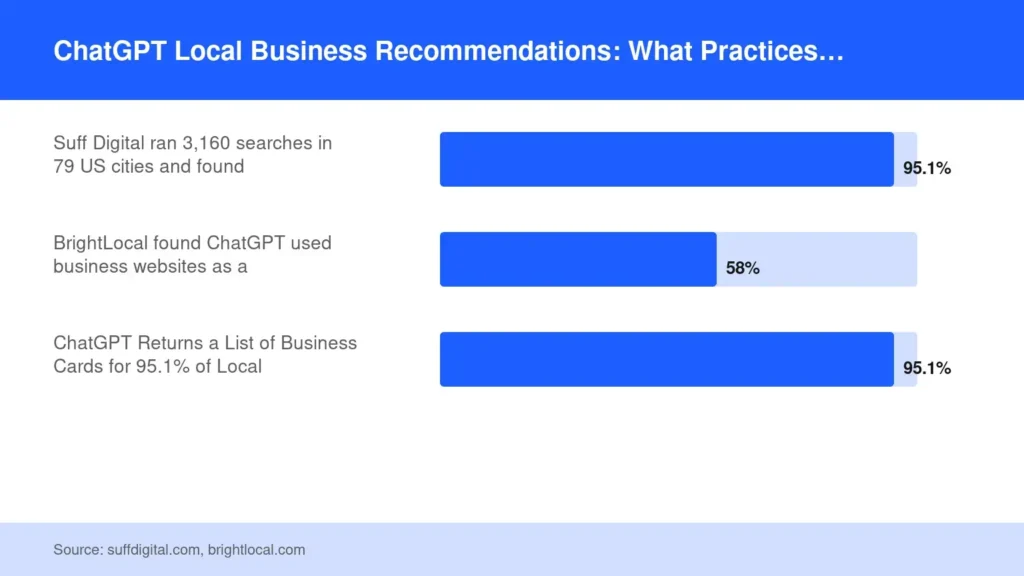
The scale is clear. Suff Digital ran 3,160 searches in 79 US cities and found the business-card list in 95.1% of answers, holding about 12 businesses. Dentists were among the services tested. A separate test by Linktech found 45 of 53 cited sources were directories or review lists, and only two were business websites.
That same Linktech test found the written pick matched the top of the card list in 18 of 19 answers. So the list isn’t decoration. It’s the running order, and the written answer reads straight down it.
Why do directories describe my practice instead of my website?
Directories get cited because they answer the comparison question in one place: name, address, phone, rating and category. Most practice websites never write those facts down in plain sentences that a machine can lift.
ChatGPT also leans on Bing’s index rather than Google’s. Search Engine Land reports that it only references Google ratings when a page indexed by Bing cites them. Your Google profile matters, but it isn’t the whole picture. It’s one voice in a room where the directories are talking louder.
Here is the loss to watch. Silence is a handover. If a directory is the only page describing you, you’ve handed it the microphone, and it decides what a patient reads about you. That might be an outdated category, a missing service or a stale phone line.
Is SEO dead now that people ask AI?
No. The work has moved from chasing rankings to publishing the specific facts that answer engines quote. The basics still apply: a crawlable site, accurate listings and pages that answer real questions.
Your own site still counts. BrightLocal found ChatGPT used business websites as a source 58% of the time in its December 2024 study, and it saw the same pattern again later. Sources vary, but your website stays in the mix whenever it has something worth citing.
Some people call this GEO, short for generative engine optimization. For a local practice it means the same thing good local SEO always meant. Be the clearest, most specific source about your own business.
What should a practice publish so ChatGPT can quote it?
Publish the facts a patient asks next, in plain sentences, on your own pages. The card list gets you on the shortlist. The follow-up questions decide who gets the call. Treat each follow-up as a search query a worried patient types late at night. You either answer it in your own words, or you leave the answer to whoever spoke up first.
- The services you actually offer. Give each service its own page. Leave out the ones you refer elsewhere.
- Who each service is for. Say plainly which patients it suits and which it doesn’t.
- Insurance facts. Name the plans you accept, and say what happens if you’re out of network.
- Scheduling facts. Cover same-week availability, evening or weekend hours, new-patient steps and how to book.
- Your service area. List the towns and neighborhoods you serve, in words, matching your Google Business Profile guidelines listing.
Write each answer so the first sentence stands alone. Someone should be able to quote it with no context. Our notes on AI citation content gaps and AI Mode official sites go further.
How can I get ChatGPT to recommend my business by name?
Make your name, address, phone and services match everywhere, then publish the answers directories can’t give. Consistency gets you on the list. Your own pages give the written answer something specific to say.
Start with the listings you already have. Fix your Google profile, then check the directories that show up in your own test searches. Reviews matter too. Linktech’s test found the most-reviewed business ranked first only twice, so reviews help without deciding the order. Our posts on review requests and Ask Maps cover that side.
Then keep publishing. A single services page won’t answer every question a patient asks. A steady run of short, sourced posts will, and publishing consistency is where most practices fall behind.
What do results actually look like when a practice publishes?
Results look like your own pages starting to carry the facts that directories used to carry alone. That is the realistic win: you control the description, not the ranking algorithm.
I’ve been running this method on my own four sites since September 2026. That work rewards the same thing: doing the plain basics every week, and measuring them.
So pick your next topic from your own Search Console data before you write a word. Link every figure to its source, and publish on a steady schedule.
Frequently asked questions
Does ChatGPT use my Google Business Profile?
Not directly in most cases. ChatGPT search draws heavily on Bing’s index, so Google details show up mainly when another indexed page repeats them. Keep your Google profile accurate anyway, because directories and patients copy from it, and a matching Bing Places listing closes the gap.
Not directly in most cases. ChatGPT search draws heavily on Bing’s index, so Google details show up mainly when another indexed page repeats them. Keep your Google profile accurate anyway, because directories and patients copy from it, and a matching Bing Places listing closes the gap.
Should my practice pay to be listed on more directories?
Not by default. First claim and correct the free listings that already appear in your own ChatGPT test searches, since those are the sources it is actually citing for your area. Paying for extra placements doesn’t fix a website that never states your services, insurance or hours in plain words.
Not by default. First claim and correct the free listings that already appear in your own ChatGPT test searches, since those are the sources it is actually citing for your area. Paying for extra placements doesn’t fix a website that never states your services, insurance or hours in plain words.
How do I check what ChatGPT says about my practice?
Ask it the questions your patients would ask, with your service and your city, in a private browser window. Note which businesses it lists, what the written answer says and which sources it cites. Repeat that a few times, because answers vary between runs.
Ask it the questions your patients would ask, with your service and your city, in a private browser window. Note which businesses it lists, what the written answer says and which sources it cites. Repeat that a few times, because answers vary between runs.
Can an agency do this for several practice clients?
Yes, and the method is the same for each client: matching listings, one clear page per service, and plain answers about insurance and scheduling. The hard part is keeping a publishing rhythm across many sites, which is where agencies usually need a repeatable system rather than more writers.
Yes, and the method is the same for each client: matching listings, one clear page per service, and plain answers about insurance and scheduling. The hard part is keeping a publishing rhythm across many sites, which is where agencies usually need a repeatable system rather than more writers.
Will AI-written posts hurt my practice website?
Content that is accurate, sourced and useful to patients is fine, whatever tool helped produce it. What gets penalized is mass-produced, unhelpful filler. Every figure should link to its source, and every claim about your practice should be true and specific to how you work.
Content that is accurate, sourced and useful to patients is fine, whatever tool helped produce it. What gets penalized is mass-produced, unhelpful filler. Every figure should link to its source, and every claim about your practice should be true and specific to how you work.
The Bottom Line
The business-card list gets you onto the shortlist, but right now directories are writing most of what patients read about you. Fix your listings, then publish the facts only you can state well: the services you offer, who each one is for, the insurance you take and how booking works. Whether your practice is in Dover, Delaware or across the country, the patient asking ChatGPT wants those same plain answers.
You don’t have to become a writer to do it. Every question you leave unanswered is a quiet handover to a directory. Short, plain, sourced answers, published every week, take the description back.
Start free for 14 days
Sources
- ChatGPT Returns a List of Business Cards for 95.1% of Local Questions — Suff Digital
- How ChatGPT Picks Local Businesses — Linktech Solutions
- How does ChatGPT conduct local searches? — Search Engine Land
- AI search using listings as sources — BrightLocal
- Uncovering ChatGPT Search Sources — BrightLocal
- Guidelines for representing your business on Google — Google Business Profile Help