Search Console AI Impressions: What to Do With Them Now
Key takeaways
- Search Console AI impressions tell you one thing clearly: how often a link to your pages was shown to someone within Google's generative AI features, page by page, country by country, day by day.
- They do not tell you what anyone asked, whether anyone clicked, or how AI clicks compare with ordinary ones, and a site with too few impressions may see no report at all.
Search Console AI impressions tell you one thing clearly: how often a link to your pages was shown to someone within Google's generative AI features, page by page, country by country, day by day. They do not tell you what anyone asked, whether anyone clicked, or how AI clicks compare with ordinary ones, and a site with too few impressions may see no report at all. The ten-minute use of this data is to list the pages AI answers already cite, name the question each one answers, and then write down the obvious patient question that has no page behind it.
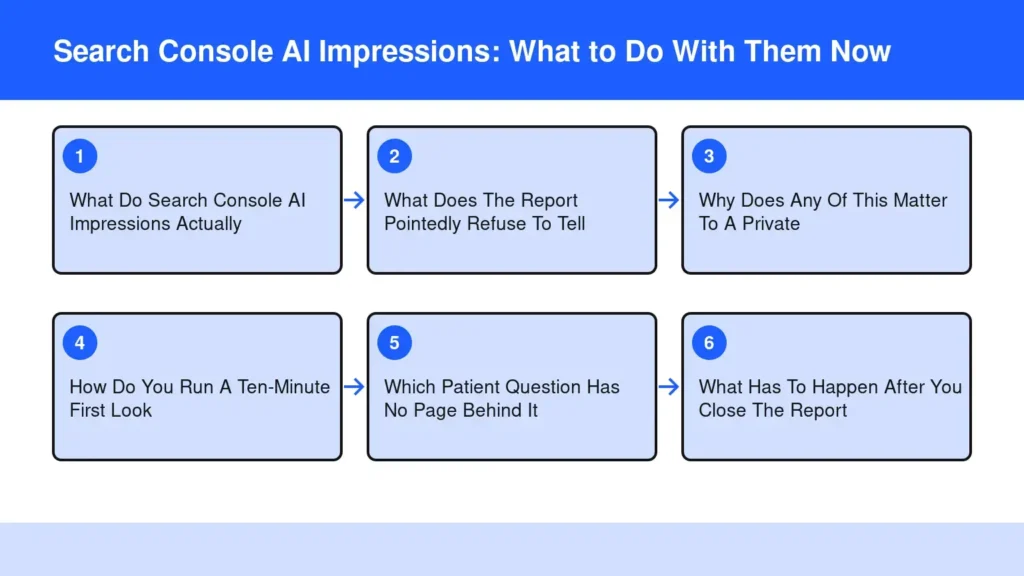
What Do Search Console AI Impressions Actually Count?
They count how many times a link to your site was shown to someone within Google’s generative AI features. That is it. In the dedicated view, Search Console reports impressions from generative AI features on Google Search, including AI Overviews and AI Mode, and how they change over time, with a matching report for generative AI features in Discover, broken down by page, country, device and date.
The counting rule is stricter than most owners assume. Google states that only one impression is counted per result per session, so a reader who scrolls past your card and then scrolls back is still one impression. An impression is not a visit and not a ranking; it is evidence that an AI answer put your page in front of a person who asked something.
This data is new on the screen for most practices. Google announced the reports in June 2026 and later added a note that as of 31 August 2026 the insights had rolled out to all websites worldwide, after a phased release that left most small sites looking at nothing. Search Engine Land reported the same date for the global rollout of the AI performance reports and the Search generative AI control.
What Does The Report Pointedly Refuse To Tell You?
It will not tell you what anyone asked, and it will not tell you whether anyone clicked. The dedicated view is impressions only, and clicks are not split out by feature. Google says the generative AI data is still tracked inside the overall performance report so owners can see total site visibility in Search, which means AI clicks are counted somewhere and never labelled, per its own announcement of the reports.
It may also refuse to appear at all. Google’s help page lists the reasons a property shows nothing: not all properties have access while the rollout continues, or the site has not received enough impressions in generative AI features on Google Search. Search Engine Journal noted that those help pages still say access is incomplete even after Google said the reports had reached everyone. A small practice site with a couple of thin service pages is exactly the property that sees an empty tab.
So read it for what it is. A full picture of position, queries and traffic from AI answers does not exist yet, in this report or in any tool that claims otherwise. What you do have is a page-level list of where you already appear, and the far more useful silence around every page you never wrote.
Why Does Any Of This Matter To A Private Practice?
Because the answer now happens above the search results, and the click is getting rarer. Pew Research Center tracked the browsing of 900 US adults and found that users who met an AI summary clicked a result on 8% of visits, against 15% when no summary appeared, and clicked a link inside the summary itself only 1% of the time.
Read that as an owner rather than a marketer. When someone types a question about a procedure, a wait time or an insurance plan, a paragraph assembled from somebody’s published page answers it. That is the mechanism behind losing patients to competitor content you never published. Appearing within the answer is now the prize, and what practices must publish to get found by AI answer engines is no mystery: pages that answer real questions, sourced, with a human name on them.
The scale is the part that should land. In the same analysis, 58% of participants ran at least one Google search in March 2025 that produced an AI summary. This is not a fringe surface you can wait out.
How Do You Run A Ten-Minute First Look?
Open the report, switch to the pages view, and write down the question each winning page answers. Ten minutes is genuinely enough for a first pass, and you do not need an analyst to do it.
- Minute one. Open Search Console, pick the property, go to the performance section and expand the generative AI view for Search.
- Minutes two to four. Set the longest date range available and switch to the pages dimension. Note the pages at the top of the list.
- Minutes five to seven. Open each of them and write, in one line, the question it answers. Not the keyword. The question a patient would say out loud.
- Minute eight. Check the countries view. National and global impressions on a local practice page usually mean you published a general explainer, which is fine, but it is not the same as being found by a neighbour.
- Minutes nine and ten. List the questions your front desk answered on the phone in the past week that have no page at all. That list is your publishing queue.
Those winning pages show you the register Google’s AI features already trust from your site. If none exist yet, the report is still working correctly; you simply have nothing published for it to count.
Which Patient Question Has No Page Behind It?
The one your front desk answers out loud every day and nobody has ever typed onto your site. No report can show you this, because Search Console only measures pages that exist. The gap lives in your phone log, not in your data.
Parking. Whether you take a particular plan. Whether a child can be seen the same day. What a first appointment involves and how long it takes. How to get records sent to another provider. I have written before about what one week of calls tells you, and the shortlist in front desk questions your website pages should answer first.
I spent years reading numbers for a living before any of this. I was a strength and conditioning coach for the Toronto Blue Jays, the Tampa Bay Buccaneers and the University of South Florida, and the pattern holds everywhere: the measurement tells you where to look, never what to do. A report that shows which pages AI answers cite is a measurement. The work is the page you publish because of it.
What Has To Happen After You Close The Report?
Something has to publish, in your voice, week after week, or the report only documents a decline politely. That is the part most coverage skips. Measuring visibility changes nothing by itself, because the only input these features respond to is published, sourced, answerable pages.
That loop is why I do this work at all, and why I built a system around it. The first app is Blog & Social Posts, Done for You: topics chosen from the questions your patients actually ask, every figure linked to the page it came from, and a human name on the byline. I have held to that same discipline on my own sites for years, and the details sit on the pricing page.
If you want to see the deciding half before anything publishes, the free report returns six researched topics for any website. Agencies can send the same report under their own name and logo.
Frequently asked questions
Can I keep my pages out of Google's AI features?
Yes. Alongside the reports, a Search generative AI control rolled out globally on 31 August 2026 as a property-level setting that removes a site from those AI surfaces. For a practice that wants new patients to find it, switching that off is almost always the wrong move. Read the data first, then decide.
Yes. Alongside the reports, a Search generative AI control rolled out globally on 31 August 2026 as a property-level setting that removes a site from those AI surfaces. For a practice that wants new patients to find it, switching that off is almost always the wrong move. Read the data first, then decide.
Why did my AI impressions fall in August 2026?
Probably a logging error rather than a ranking change. Google confirmed a data logging issue that lowered reported impressions in the generative AI report for Search from 13 August 2026 and said it affected reporting, not real visibility. If your chart shows a cliff near that date, check your overall numbers before rewriting anything.
Probably a logging error rather than a ranking change. Google confirmed a data logging issue that lowered reported impressions in the generative AI report for Search from 13 August 2026 and said it affected reporting, not real visibility. If your chart shows a cliff near that date, check your overall numbers before rewriting anything.
Does this report replace my normal Search Console performance data?
No. It is an additional view that isolates generative AI features, and your classic web report keeps its clicks, impressions, average position and query data. Use the AI view to see which pages the answer layer draws on, and the classic report to see what still earns a visit. They answer different questions.
No. It is an additional view that isolates generative AI features, and your classic web report keeps its clicks, impressions, average position and query data. Use the AI view to see which pages the answer layer draws on, and the classic report to see what still earns a visit. They answer different questions.
How often should a practice owner check this report?
Once a month is plenty, with a longer look each quarter. The data moves slowly, and the decisions it drives, which topics to cover next, are monthly decisions anyway. Checking daily invites you to read noise as a trend and to rewrite pages that were never the problem in the first place.
Once a month is plenty, with a longer look each quarter. The data moves slowly, and the decisions it drives, which topics to cover next, are monthly decisions anyway. Checking daily invites you to read noise as a trend and to rewrite pages that were never the problem in the first place.
Should my agency pull this report for clients?
Yes, and it starts an easy conversation. A page-level list of what AI answers already cite, set beside the questions a client cannot answer anywhere on their site, makes the gap obvious without an argument. The partner program exists for agencies that would rather sell the publishing than staff it.
Yes, and it starts an easy conversation. A page-level list of what AI answers already cite, set beside the questions a client cannot answer anywhere on their site, makes the gap obvious without an argument. The partner program exists for agencies that would rather sell the publishing than staff it.
The Bottom Line
The report is not an SEO scorecard and it is not a verdict on your site. It is a short, honest list of the pages Google’s AI features found worth citing, and a much longer unwritten list of the questions nobody at your practice has answered in public yet. Ten minutes gets you both lists.
- Open the generative AI view in Search Console and sort by page.
- Name the question each appearing page answers, in your own words.
- Write down the front desk questions with no page behind them.
- Decide who publishes the answers, every week, before the queue goes cold.
If the last line is where it always stalls, that is the problem we built for. Start with the free report, read the free book if you want the reasoning, and when you are ready to have the posts written in your voice and published for you, try it. Questions are always welcome.
Start free for 14 days
Sources
- Introducing Search Generative AI performance reports in Search Console – Google Search Central Blog
- Generative AI performance report (Search) – Search Console Help
- Generative AI performance report (Discover) – Search Console Help
- Google Search Console AI performance reports and Search generative AI control rolling out globally – Search Engine Land
- Google Search Console AI Reports Rolled Out Worldwide – Search Engine Journal
- Google Search Console Generative AI Performance Report in Search data bug – Search Engine Land
- Google users are less likely to click on links when an AI summary appears in the results – Pew Research Center