Best for searches AI Overviews: get cited for what you treat
Key takeaways
- Best for searches AI Overviews now answer a patient's question in writing before any list of links, so a search like best physical therapist for a rotator cuff is decided by whichever page the summary cites.
- A practice gets cited by answering two or three best for questions from its own first-hand work, with facts no directory or chain can match.
Best for searches AI Overviews now answer a patient's question in writing before any list of links, so a search like best physical therapist for a rotator cuff is decided by whichever page the summary cites. A practice gets cited by answering two or three best for questions from its own first-hand work, with facts no directory or chain can match. If the practice cannot name two such facts for a question, that page should not be written yet.
What do best for searches AI Overviews mean for a practice?
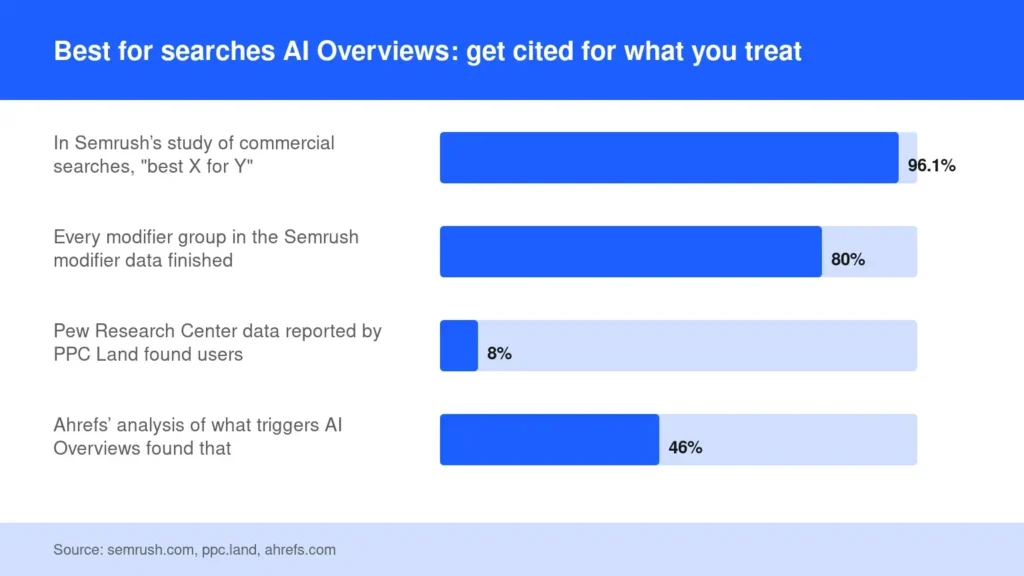
They mean a patient who types a “best for” question now reads a written answer before any list of links. In Semrush’s study of commercial searches, “best X for Y” searches finished with the highest AI Overview coverage of any modifier, at 96.12%. So a search like “best physical therapist for a rotator cuff” gets a summary first, and the summary decides which practices are worth a look.
The same study tracked other buying searches too. Every modifier group in the Semrush modifier data finished above 80% coverage, and searches with “reviews” in them had shown an overview less than a third of the time a year before the study ended. Comparison, price and review searches all now land on a written answer. For a practice, that covers most of the questions a patient asks right before booking.
The click picture matters as well. Pew Research Center data reported by PPC Land found users who saw an AI summary clicked a traditional result in 8% of visits, against 15% without one. Fewer clicks reach the page, so the summary itself has to carry your name. For more on that, see our look at what still gets read.
This is a new feature of the results page, not a passing test. Many practices still measure success by traffic and top rankings, while the overview quietly answers the patient above both. The question to ask is no longer only where you rank. It is whether the summary uses your page as a source, and whether your name appears in the AI-generated answer at all.
Is SEO dead, or is it changing what a practice should publish?
SEO is not dead; it has moved from ranking a page to being the source an answer quotes. The work is still search work. The target is now a sentence an overview can lift, not a keyword repeated down a page.
Google’s own guidance points the same way. Its help document on helpful, reliable, people-first content was updated to stress main content, the part of the page that does the actual job for the reader. Search Engine Land’s walkthrough of people-first writing describes the same shift: write for the person first, and treat search as the way they find you.
Question length matters too. Ahrefs’ analysis of what triggers AI Overviews found that 46% of queries of seven words or more trigger one, and 44% of medical YMYL queries do. A patient’s “best for” question is usually long, specific and health-related. That is the exact shape that draws an overview, so the practice with the clearest written answer has the best chance of being cited.
How do you find the best for questions your practice can answer?
Start from what you treat most and do best, then phrase it the way a patient would search it. You want two or three questions, not twenty. Each one should be a question where your own work gives you something to say that a directory or a national chain cannot.
A short checklist for choosing them
- Name the condition you see every week. Pair it with who the patient is: a runner, a desk worker, a parent after pregnancy.
- Write the search the way the patient types it. “Best chiropractor for lower back pain from sitting” beats “spinal care services.”
- Ask what only you can add. Your method, your follow-up, the equipment you use, the mistake you see patients make before they come in.
- Check that you can say it twice. If you cannot name two facts only your practice holds, pick another question.
- Keep it inside your scope. A “best for” page is a claim, so it should rest on what you actually do.
Where the questions hide
The front desk hears them all day. The phone questions, the intake forms and the reviews patients leave are full of “is this the right place for” wording. Search Console shows the queries that already bring people to your site, including long ones you never wrote a page for. Those repeats are the list. The method is to count them, not to brainstorm.
Look for patterns rather than single questions. If patients keep asking whether you treat a condition in a certain group, such as older golfers or new mothers, that pairing is a “best for” search waiting to be answered. Write down the exact words they use. Those words, not industry terms, are what they type into Google later that night.
Why do a practice's own facts decide whether a post gets written?
Because a “best for” answer with nothing first-hand in it gives an overview no reason to cite you over anyone else. A draft that cannot say two things only that business can say is set aside, not published.
That rule has teeth. On one of my own sites, in a single October week, the review set aside 9 of 14 drafts. The topics were fine. The site’s facts simply held too little that only that business could say. First-hand facts decide whether a post can be published, and no amount of tidy writing makes up for their absence.
I run a multi-location wellness practice alongside film and book sites, and the lesson from them is plain. Start a draft from the practice’s real methods, locations and results, and posts get through. Start it from a thin About page, and most drafts stop at review. If you want to see what that review checks, our post on reviewing AI content before publishing walks through it.
Setting a draft aside feels like a loss in the moment. It is cheaper than publishing a page that sounds like every other practice, because that page earns no citation and still carries your name. Before anything is written, list the facts the practice can stand behind. If that list is short, the first job is to gather more of them, not to write more posts.
Do you need an AI Overview tracking tool to see where you stand?
Most independent practices don’t need a dedicated AI Overview tracker to start; they need to know which questions to answer first. An AI Overviews tracking tool records which prompts show an overview and which sources it cited. That is useful data, but it tells you where you are missing, not what to write.
How to choose the right tracker, if you want one
- Custom prompts. It should track your own local “best for” questions, not only a generic keyword list.
- Cited sources. It should show which pages the overview cited, so you can see who answers in your place.
- Local results. Rank and visibility change by location, so the tool needs to check from where your patients search.
- Brand mentions. Tracking mentions of your practice name across AI platforms shows whether the answer engines know you exist.
- Easy access for your agency. If someone else builds your site, they need the same view.
Agencies feel this more than owners do. A client wants to see where their brand stands in Google’s AI Overviews, and a rank PDF no longer tells the story. Search Engine Land’s summary of the Semrush data advises brands to make sure they compete for visibility in Google’s AI answers. For agencies, the agency report puts the same publishing advice under your own name.
Tracking features vary a lot between vendors, so read what each one actually checks before you pay. Some report insights on brand mentions across answer platforms; others only flag whether an overview appeared. Either way, the data is a mirror. It shows the gap, and the gap only closes when the practice publishes the answer.
What should a best for page include so an overview cites it?
It should answer the question in its first sentence and then prove the answer with facts only you hold. Overviews lift the opening line, and inline links reward the one sentence that answers first. Everything after that sentence is evidence.
A strong page should include these parts:
- A one-sentence answer. Say who the practice is best for and why, plainly.
- Your method, named. Describe what happens at the first visit, in your own words.
- Who it is not for. Saying when you refer out builds more trust than a claim to treat everyone.
- The practitioner’s name and credentials. A real byline gives the page a person to stand behind it.
- Sources for every figure. Any outside number links to the page it came from.
- Your own photo where one fits. A real room or a real piece of equipment says more than a stock image.
Keep each page to one question. A page that tries to be best for everything is best for nothing an overview can quote. If accuracy worries you on health topics, check one page before lunch with the steps in that post.
Frequently asked questions
What are the best AI websites for finding a local practice?
Google Search with AI Overviews, Google Maps, ChatGPT and other answer engines are the places patients now ask. Each one summarizes sources rather than listing every option. A practice that publishes clear, first-hand answers on its own site gives all of these platforms the same thing to draw on, so one good page can serve several of them.
Which search engine matters most for a private practice?
Google still matters most for most practices, because its search results, Maps listings and AI Overviews sit in front of the largest share of local searches. That does not mean ignoring the others. The pages that help you in Google’s summaries are the same ones ChatGPT and similar tools read, so the work carries over.
Are AI Overviews trackers suitable for all businesses?
No, they suit businesses that already publish steadily and want to measure the effect. A small practice with few pages gains little from tracking prompts it has no answer for yet. Publishing the first few strong answers comes first, and tracking becomes worth the time once there is something on the site to track.
Can a practice write best for pages without becoming a writer?
Yes, if the facts come from the practice and the drafting is handled for it. The owner’s job is to supply what only they know: methods, patients they serve best, and the questions the front desk hears. A tool or a writer can shape that into pages, as long as each one is reviewed before it goes live.
Is it honest to call your own practice the best for something?
It is honest when the page shows why, rather than just asserting it. Explain who you treat most, how you treat them, and when you would send someone elsewhere. Readers and answer engines both trust a specific, limited claim backed by first-hand detail far more than a broad boast with nothing under it.
The Bottom Line
“Best for” questions now get a written answer first, and that answer cites whoever wrote the clearest first-hand page. Pick the two or three questions your practice can answer from its own work. Write each one so it answers in the first sentence, then back it with facts nobody else holds. Skip the ones where you have nothing of your own to say.
To find your own questions, start with the free report, What should you publish next? It gives six researched topics for your site. For the longer story of how search got here, the free book covers it.
Start free for 14 days
Sources
- AI Overviews have nearly doubled across five commercial search modifiers [Study] – Semrush
- Google AI Overviews nearly double for commercial keywords: Study – Search Engine Land
- What Triggers AI Overviews? 86 Factors and 146 Million SERPs Analyzed – Ahrefs
- AI search summaries reduce link clicks for Google users – PPC Land
- Google Updates Helpful Content Page With Main Content – Search Engine Roundtable
- Writing people-first content: A process and template – Search Engine Land