User Generated Spam AI Tools: What to Ask Before You Resell
Key takeaways
- Google's guidance on user-generated spam now covers tools that let users publish generated content, so the tool's own behaviour gets judged, not just the client's.
- Before an agency puts a client's domain on an AI writing tool, it should ask four things.
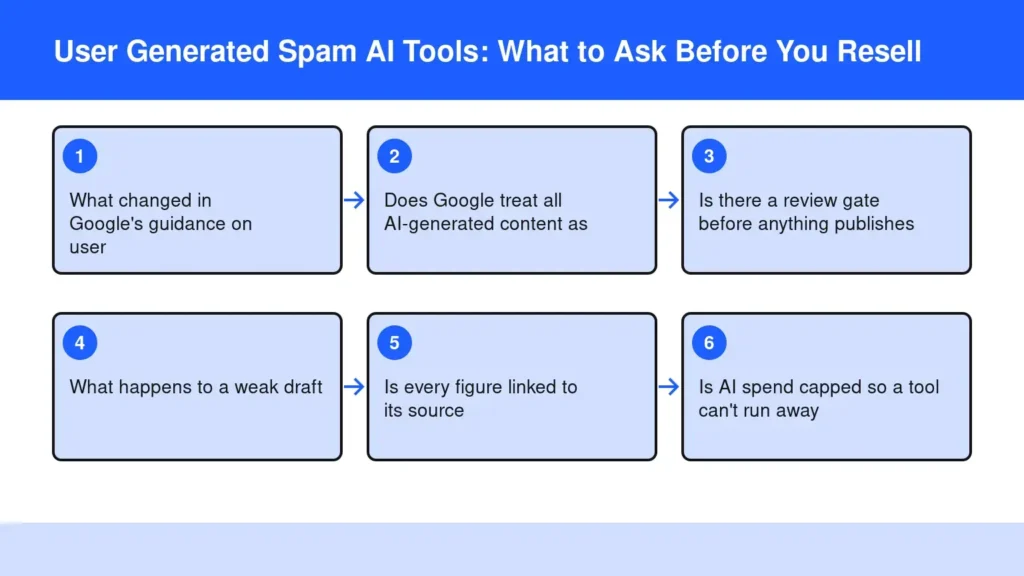
Google's guidance on user-generated spam now covers tools that let users publish generated content, so the tool's own behaviour gets judged, not just the client's. Before an agency puts a client's domain on an AI writing tool, it should ask four things. Is there a review gate? What happens to a weak draft? Is every figure sourced? Is spend capped? A tool that can't answer all four puts the client's site at risk.
What changed in Google's guidance on user generated spam AI tools?
Google’s guidance on user generated spam AI tools now names the platform as well as the person using it. Search Engine Roundtable reported that the help document now covers tools that let users publish shared pages, generated content or web apps. That one wording change moves the question from the client to the software behind the client.
Search Engine Land noted that the same document now tells platforms to block indexing of link-shared content and to watch for abuse in Search Console. The message to anyone running a publishing tool is simple. You answer for what your users can push out through it.
For an agency, that makes the tool part of the client’s risk. A white-label writer that publishes thin pages at scale doesn’t only hurt itself. It hurts every domain it touches.
Does Google treat all AI-generated content as spam?
No. Google judges whether a page adds value, not how it was made. Google’s own guidance on generative AI content says these tools can help with research and with adding structure to original content. The same page warns that generating many pages without adding value for users may break its spam policies.
So artificial intelligence isn’t the problem. Scale without substance is. Google’s refreshed spam policies focus on what web spam is and which tactics it uses. A legitimate tool has to stay on the right side of that line by design. Trusting every user to keep it there isn’t enough.
For the content side of the rule, see our piece on the scaled content abuse policy. The platform side is a different question: what a reseller should demand from the software before any client post goes live.
Is there a review gate before anything publishes?
The first question to ask is whether every draft passes a check before it goes live, and what that check actually tests. A tool that publishes straight from the model is just a pipe. It isn’t a writer.
The test isn’t grammar or tone. It asks whether the draft says two things only that business can say. That rule follows Google Search Essentials. For why that matters, see what first-hand experience content earns.
When an agency asks a vendor about review, the answer should name the test. “A human looks at it” isn’t a test. Neither is “the AI checks itself”.
What happens to a weak draft?
A weak draft should be set aside, not published. Ask the vendor to show you a draft it refused, because a tool that never refuses anything has no gate.
Here is what that looks like in practice. On one of my own sites, from 19 to 26 October 2026, the review set aside 9 of 14 drafts. The site’s facts held too little that only that business could say. That week taught me something I now tell every agency: first-hand facts decide whether a post can be published, and no amount of polish makes up for missing ones.
Fewer posts and a clean domain beat a full calendar and a manual action.
Is every figure linked to its source?
Every figure in a post should link to the page it came from, in the same sentence. Unsourced numbers are where generated content goes wrong first, and they are the hardest errors for a client to spot.
Google now says the same thing. Search Engine Journal reported that Google’s guidance warns AI output may contain errors and advises fact-checking it before publishing. A source link on every figure makes that check possible for your team, for the client and for any reader.
To run that check quickly, use our one-page accuracy check.
Is AI spend capped so a tool can't run away?
Yes, it should be. Ask whether a hard cap stops AI calls before they leave the site, not after the bill arrives. A runaway loop costs money. It can also publish far more than anyone meant to, and that’s exactly the pattern spam guidance targets.
For an agency managing many client domains, that cap does double duty. It protects the client’s budget and it limits how much the tool can publish.
If you resell or white-label a writing tool, these four answers belong in your vendor file. Our Partner program is built for agencies and consultants who want those answers settled before they take on a client.
Frequently asked questions
Does a photo or diagram help an AI post avoid looking generated?
A relevant image helps readers, and readers are what Google’s guidance protects. Otherwise it makes a diagram, chart or sketch from the post itself, so the picture supports the point instead of being generic stock decoration.
How do I know a vendor's review gate is real?
Ask to see drafts it rejected and the reason it gave for each one. A real gate tests something specific, such as whether the draft holds facts only that business can state. If a vendor has never set a draft aside, the gate exists on paper and nowhere else.
Should an agency sell AI posts to a client with few first-hand facts?
Gather facts first and publish second. A client with little to say that is truly their own will see most drafts set aside by a strict review, and that is the right outcome. Spend the first weeks collecting their methods, credentials and local specifics, so the tool has real material to write from.
Where can I learn how search and AI answers reward content now?
It’s a plain read for owners and for agencies who explain these choices to clients.
The Bottom Line
Google’s spam guidance now looks at the tool as well as the user, so an agency’s due diligence has to cover the software too. Ask the four questions: is there a review gate, what happens to a weak draft, is every figure sourced, and is spend capped? Get the answers in writing before any client domain goes on the tool.
If you resell writing software to clients, take a look at our Partner program.
Start free for 14 days
Sources
- Google Updates User-Generated Spam Guidance To Specify Tools & More
- Google Search says you should block indexing of link-shared content
- Google Search's guidance on using generative AI content on your website
- Google updates its spam policies document
- Google Search Essentials
- Google Tells Sites To Fact-Check AI Content Before Publishing
- Google site reputation abuse policy now includes first-party involvement or oversight of content