Scaled Content Abuse Policy and the Safe Way to Post Daily
No. Publishing weekly or daily does not make you an AI content farm in Google's eyes, because the scaled content abuse policy targets pages made mainly to manipulate rankings with little value to readers, not the tool or the pace. What separates a busy practice blog from a farm is that each post answers real demand, links its figures to sources, and says things only that practice could say.
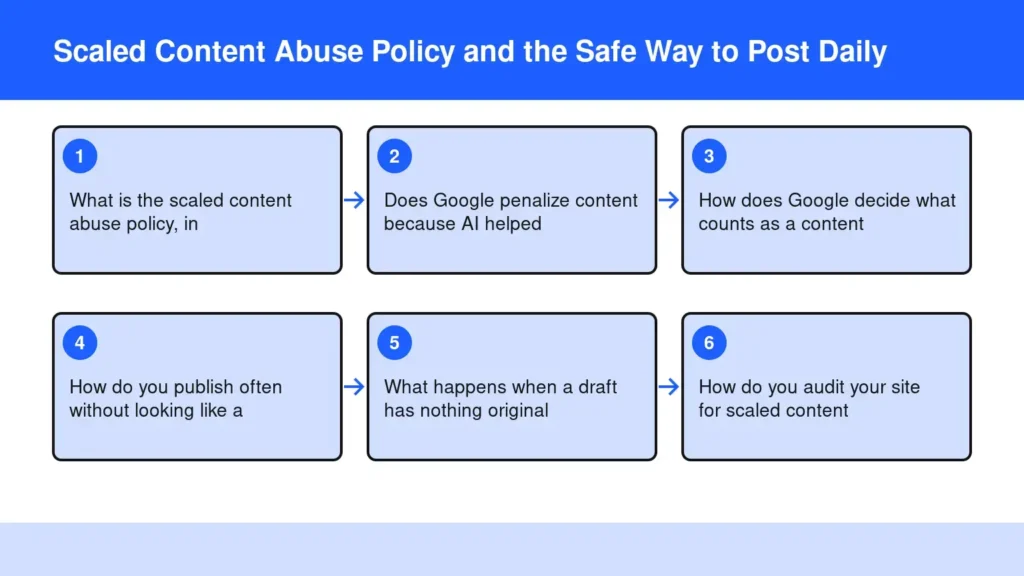
What is the scaled content abuse policy, in plain words?
The scaled content abuse policy is Google’s rule against producing many pages mainly to game rankings rather than help readers. Google defines it as many pages generated for the primary purpose of manipulating Search rankings and not helping users. The key words are primary purpose. Volume alone is not the offence.
The same Google announcement says the abuse typically means large amounts of unoriginal content that gives little value. Examples Google lists include using generative AI tools to churn out pages without adding value, and stitching together content from other pages. Neither example mentions a publishing schedule.
So a practice owner asking whether a weekly post is risky is asking the wrong question. The right question is whether each page would still deserve to exist if search engines did not.
Does Google penalize content because AI helped write it?
No. Google’s guidance says the method of production is not the violation; using automation mainly to manipulate rankings is. Its guidance about AI-generated content describes rewarding high-quality content however it is produced.
Google’s guidance on using generative AI content goes further. It calls generative AI particularly useful for researching a topic and adding structure to original content. The warning in that same page is about producing many pages without adding value for users.
That is the line I care about. A tool can do the typing. It cannot be the reason the page exists.
How does Google decide what counts as a content farm?
Google judges the pattern across a site, through automated systems and, sometimes, human reviewers. Its automated spam systems run all the time, and spam updates are, in the words of Google’s spam update documentation as reported by Search Engine Roundtable, notable improvements to how they work.
When the pattern is severe, a human can act. The Manual actions report in Search Console Help names scaled content abuse among the aggressive spam techniques behind a major spam problem. Sites that break the spam policies may rank lower or not appear in results at all.
What the farm pattern looks like in practice:
- Many pages that answer no question a real person searched.
- Pages that rephrase what other sites already say, with nothing new.
- Templates that swap a city or a keyword and change little else.
- Figures with no source and claims nobody could check.
Our piece on programmatic SEO for practice websites covers that trap in depth.
How do you publish often without looking like a farm?
You make every post earn its place before it is written.
Decide each post by real demand
A farm publishes because the calendar says so. A useful site publishes because people are asking. Our guide to AI citation content gaps shows how to find those questions.
Link every figure to where it came from
Stitched content hides its sources because it has nothing of its own. A post that links each figure to the page it came from is the opposite: a reader can check it, and the value is visible.
Put the practice’s own experience in the text
This is the safeguard no farm can copy. How your team handles a first visit, what you see in a season, the method you actually use. Our piece on first-hand experience content explains why Google rewards it.
What happens when a draft has nothing original to say?
It should be set aside, not published.
That rule has teeth. On one of my own sites, over a single week, the review set aside 9 of 14 drafts because the site’s facts held too little that only that business could say. That week taught me that first-hand facts, not the writing, decide whether a post can be published.
I run a multi-location wellness practice alongside my own film and book sites, and those sites are where the set-aside rule was earned. A publishing habit that ships everything it drafts is the pattern the policy describes.
How do you audit your site for scaled content abuse?
Read your own pages as a stranger would and ask whether each one helps a real person. A simple pass takes an afternoon.
- Open Search Console and check the Manual actions report first; if it is clean, no human reviewer has flagged the site.
- List pages with no traffic and ask whether anyone would miss them.
- Find near-duplicates, such as service pages that differ only by town name.
- Check each figure for a link to its source.
- Look for your own voice: one detail per page that only your practice could write.
Improve the pages worth saving, merge the near-duplicates, and remove the rest. For health pages, read our piece on helpful content accuracy, and if traffic already fell, start with Google ranking update history.
Frequently asked questions
How do you recover from a Google manual action for spam?
Fix the problem across the whole site, then request a review in Search Console. The Manual actions report explains each issue and links to the reconsideration request. Describe what you removed or improved in plain terms, because a human reads it, and expect the review to take time before rankings can return.
Does Google penalize keyword stuffing?
Yes. Keyword stuffing is listed in Google’s spam policies as a manipulative practice, and pages that repeat a phrase unnaturally can rank lower. Write the phrase where it fits a sentence a person would say, then stop. Readers notice repetition before search systems do, and both reward a page that simply answers the question.
Which spam policies did Google add alongside scaled content abuse?
Google introduced scaled content abuse together with expired domain abuse and site reputation abuse. Expired domain abuse means buying an old domain to borrow its reputation for unrelated content. Site reputation abuse means third-party pages hosted on a trusted site to exploit its ranking signals, sometimes called parasite SEO.
Is publishing every day too often for a small practice?
Frequency is not the risk; empty posts are. Daily publishing works only when there are enough real questions and enough first-hand material to answer them. If drafts start repeating each other or lack anything only your practice could say, publish less often until you have more to say.
Do guest posts or syndicated articles count as scaled content?
They can if they are copied or thin. Republishing articles found elsewhere without adding anything is the stitching pattern Google describes. A guest piece written for your readers, with a named author and original insight, is ordinary publishing and carries no special risk.
The Bottom Line
Google does not count your posts. It asks why each one exists. Decide every post by real demand, link every figure, put your own experience in the text, and set aside any draft that has nothing of yours in it. Do that and a weekly or daily schedule is simply a practice that answers its patients in writing.
If you want to keep the habit steady, read our notes on practice website publishing consistency and our check of what to look at first after a spam update.
Start free for 14 days
Sources
- What web creators should know about our March 2024 core update and new spam policies
- Google Search's guidance about AI-generated content
- Google Search's guidance on using generative AI content on your website
- Manual actions report – Search Console Help
- Google September 2026 Spam Update Is Rolling Out
- Received a Pure Spam Manual Action Notice